Case study · Manufacturing website
A factory websitethat answers the buyerbefore they ask
Kestrel Precision Works is a website I designed and built as a demo for a CNC parts manufacturer that exports. This is the full walkthrough: what each section does, how a buyer uses it, and the psychology that turns a cautious procurement manager into a drawing in your inbox.
In one minute
- The site is built around the five questions every industrial buyer asks, answered in that order.
- An instant estimate gives a price range, lead time, MOQ and the saving at each order size.
- Live capacity shows how many machines are running and the next free week per process.
- Quality is shown as numbers and a real-looking inspection report, not adjectives.
- Overseas buyers see the landed cost at their door, and every buyer can track their batch.
Who this is for
Contract manufacturers, machine shops, fabricators, foundries and any B2B maker selling to buyers who send drawings and compare suppliers.
Every idea here works on an existing site too. There’s a checklist at the end.
Jump to the checklistOn this page
- Start with the buyer, not the factory
- A hero that speaks an engineer’s language
- Capabilities as numbers you can check
- An instant estimate instead of “contact us for a quote”
- Live capacity: what is running now, and when yours can start
- A factory tour that works like a supplier audit
- Quality as numbers and documents, not adjectives
- What it costs at the buyer’s door
- Batch tracking that ends the “any update?” email
- Case studies with numbers, and an engineer at the end
- It works on a phone
- The psychology at a glance
- Steal this for your own factory website
- Questions people ask
Industrial buyers don’t browse supplier websites for fun. They arrive with a drawing, a deadline and a problem: their current supplier is late, too expensive or shipping parts out of tolerance. They are looking for a reason to trust a stranger with a production line.
Most manufacturer websites give them nothing to go on. A factory photo, a list of machines, the words “quality” and “precision”, and a contact form. The buyer emails five suppliers, waits two days, and picks whoever answers first with a believable number.
With Kestrel I set one rule: every section has to answer a buyer’s question with something they can check. Below is each section in the order you meet it, with the screenshot, what it does and the psychology behind it.
Kestrel is a design demo. The company, photos, prices, certificates, customers and figures are fictional placeholders, and for a real client they are replaced with the real ones before launch. The design decisions and the psychology are what this post is about.
Step 01
Start with the buyer, not the factory
People who visit a manufacturer’s website are not browsing. They are procurement managers and engineers with a drawing, a deadline and a supplier who has just let them down. Changing supplier is risky for them personally: if the new one ships bad parts, it is their name on the decision.
Before designing anything I wrote down what that buyer needs to know, in their own words. It came down to five questions:
- Can you hold my tolerance?
- Is your quality proven?
- Do you have capacity, and how fast?
- What will it cost, landed at my door?
- Will I know what’s happening after I order?
Most manufacturer websites answer none of them. They show a factory photo, a paragraph about “state-of-the-art machinery” and a contact form. The buyer has to email, wait two days and hope. Kestrel answers all five on one page, in that order, and each answer becomes a section of the site.
For the manufacturer: buyers who would have left to email three other suppliers can get their answers, and their nerves settled, on your page.
Step 02
A hero that speaks an engineer’s language
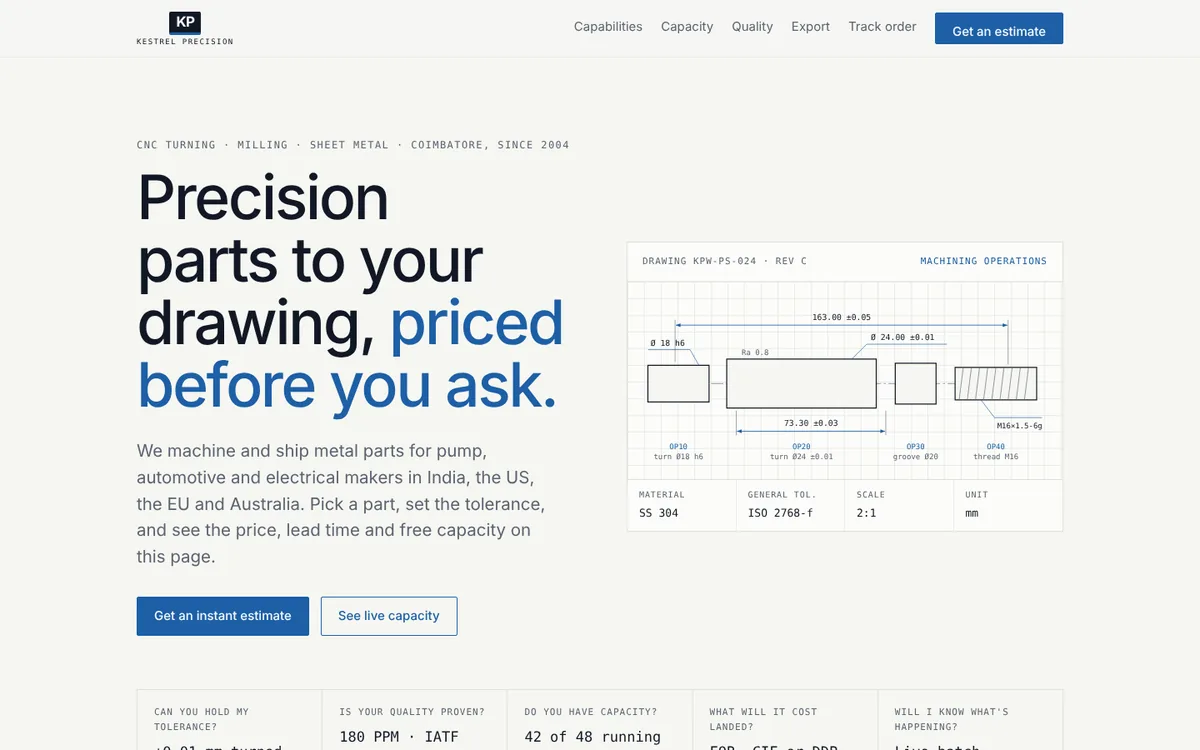
The headline makes the boldest promise on the site: “Precision parts to your drawing, priced before you ask.” The word priced is in blue, because that is what nobody else in the industry offers on a homepage.
Next to it is a technical drawing of a pump shaft, drawn the way engineers draw: dimension lines, tolerances like Ø 24.00 ±0.01, a surface finish symbol, a thread callout, and a title block with material, general tolerance (ISO 2768-f), scale and units. Every few seconds the part splits apart into its machining operations. Hovering over it holds it open.
Under the buttons is a strip with the five questions from step 1 and a short answer to each: ±0.01 mm turned, 180 PPM · IATF 16949, 42 of 48 running, FOB, CIF or DDP, and Live batch tracking. A buyer who reads only the first screen already has an answer to every worry.
For the manufacturer: engineers recognise you as one of them in the first five seconds, and stay long enough to try the estimate.
Step 03
Capabilities as numbers you can check
The capabilities section lists three processes: CNC turning, CNC milling and sheet metal. For each one it gives the numbers a buyer would otherwise have to ask for: the tolerance held in production, the maximum part size, the surface finish, the materials, and how many machines from which makers.
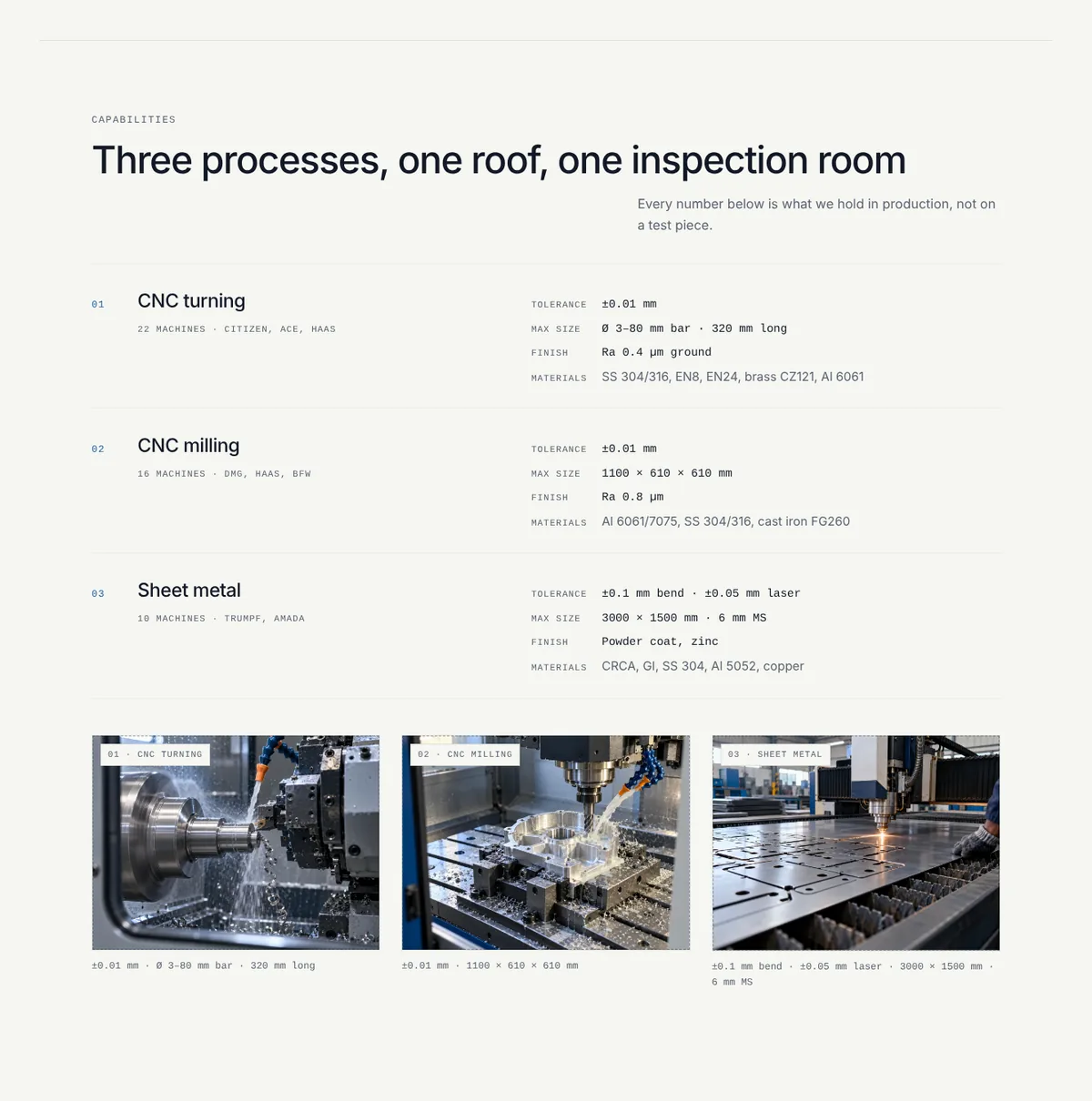
The copy is deliberately specific: ±0.01 mm, Ø 3–80 mm bar · 320 mm long, Ra 0.4 µm ground, SS 304/316, EN8, EN24, brass CZ121, Al 6061. There are no adjectives like “high precision” or “world class” anywhere.
For the manufacturer: buyers can check fit against their drawing without an email, and the enquiries you do get are for parts you can actually make.
Step 04
An instant estimate instead of “contact us for a quote”
This is the feature that makes the site different. Instead of a quote form, there is an instant estimate. The buyer drops in a drawing (or picks one of six sample parts), then chooses the material, finish, tightest tolerance and order quantity.
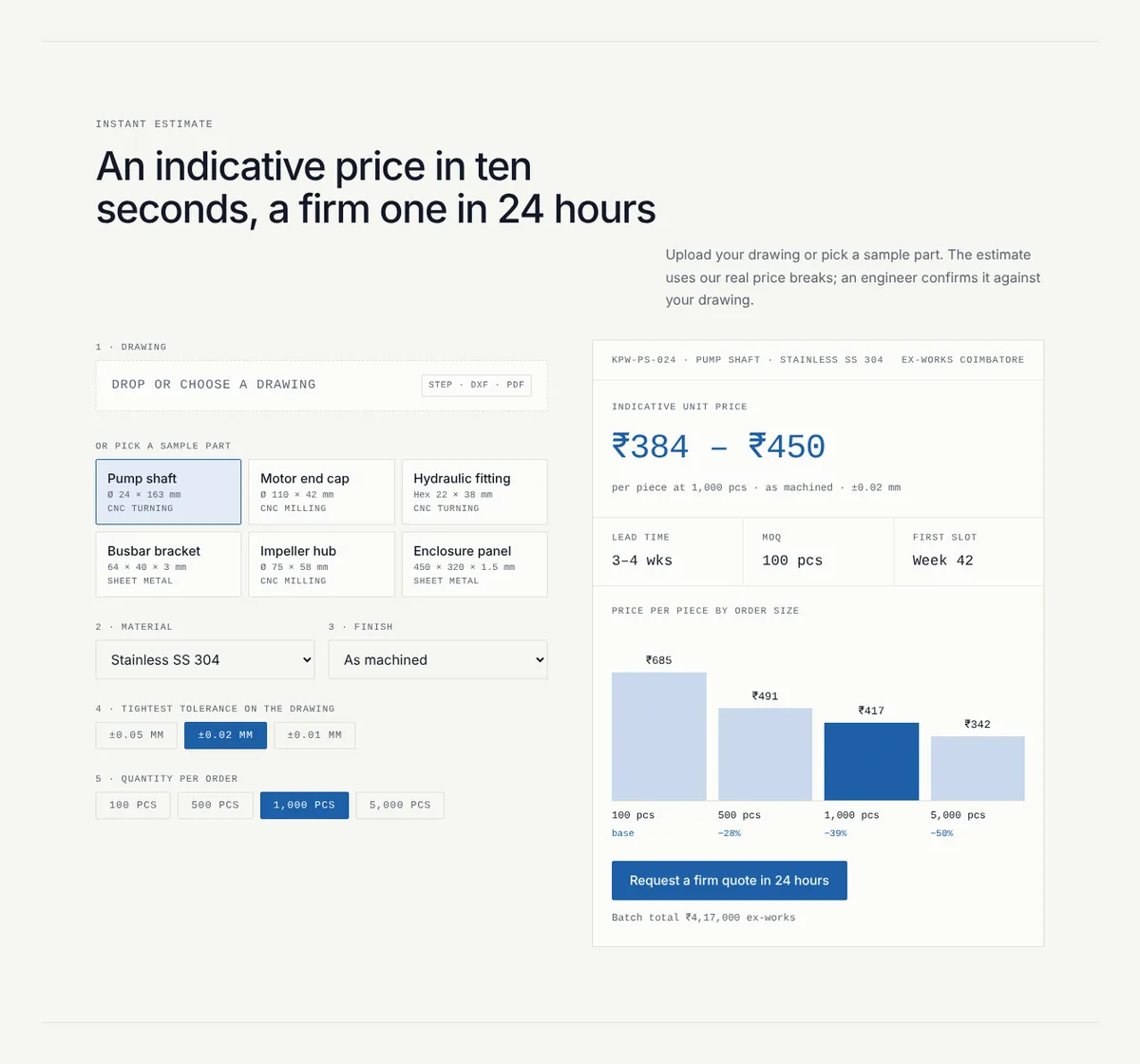
The result updates as they click:
- An indicative price range per piece, within about 8% either side of the real rate.
- Lead time, minimum order and first free slot, taken from the live capacity board. A ±0.01 mm tolerance or a 5,000-piece order adds a week, as it would on a real shop floor.
- A price-break chart showing the price per piece at 100, 500, 1,000 and 5,000 pieces, with the saving against the 100-piece price: −28%, −39%, −50%.
- The batch total, ex-works, and a button to request a firm quote within 24 hours.
The estimate is honest about what it is. It says “indicative”, and the firm price comes from an engineer who checks the drawing. That is how real quoting works; the site just removes the wait for the first number.
For the manufacturer: you get enquiries from buyers who already know your price is in their budget, often for larger quantities, and your engineers spend their time on firm quotes instead of first questions.
Step 05
Live capacity: what is running now, and when yours can start
The capacity section shows the factory floor as it stands this week. A counter reads 42 of 48 machines running, with one square per machine, green for running and empty for changeover or idle. Below it is every machine model and how many of each are running.
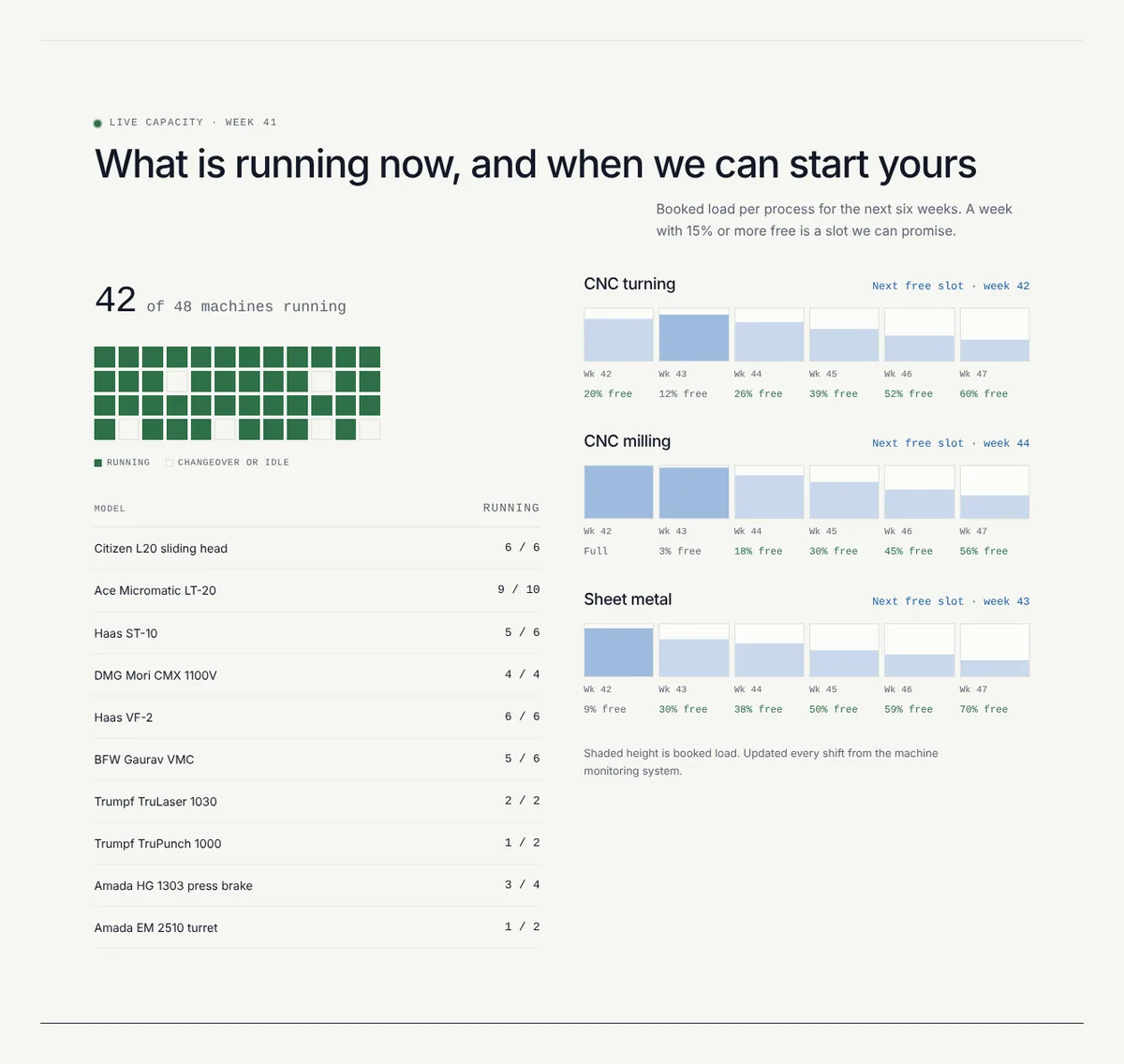
On the right are six weeks of booked load for each process, drawn as bars, with the free percentage under each week and the next free slot in blue: week 42 for turning, week 44 for milling, week 43 for sheet metal. In a live build these numbers come from the machine monitoring system, updated every shift.
For the manufacturer: buyers plan their orders around your free weeks, which fills gaps in your schedule and ends the “when can you start?” email.
Step 06
A factory tour that works like a supplier audit
A buyer can’t walk your floor before ordering, and flying an auditor out is expensive. So the site takes them on the walk. In a dark band, one pump shaft travels through six stops: raw bar stock, CNC turning, deburring and finishing, inspection, packing, and container.

Each stop shows a photo, the machine, the tolerance it holds and the check before the part moves on. For example, raw stock comes with an EN 10204 3.1 mill certificate and a spectro check per heat; turning has a first-article inspection, then 1 in 25 on critical diameters; packing has a weighed count and a photo before the carton is sealed.
On a laptop, a panel on the left stays in place as you scroll. A marker moves down the six stops and the tolerance “holding at this stop” updates. It feels like walking the route with a guide.
For the manufacturer: it replaces part of a supplier audit, shortens approval for new buyers, and gives your sales team something to send instead of a brochure.
Step 07
Quality as numbers and documents, not adjectives
The quality section opens with four numbers that count up as you reach them: 180 PPM defects over a rolling 12 months, 97.4% on-time delivery, 98.6% first-pass yield and a minimum Cpk of 1.33 on critical dimensions. Under them are the certificates: ISO 9001, IATF 16949 for automotive and ISO 14001.
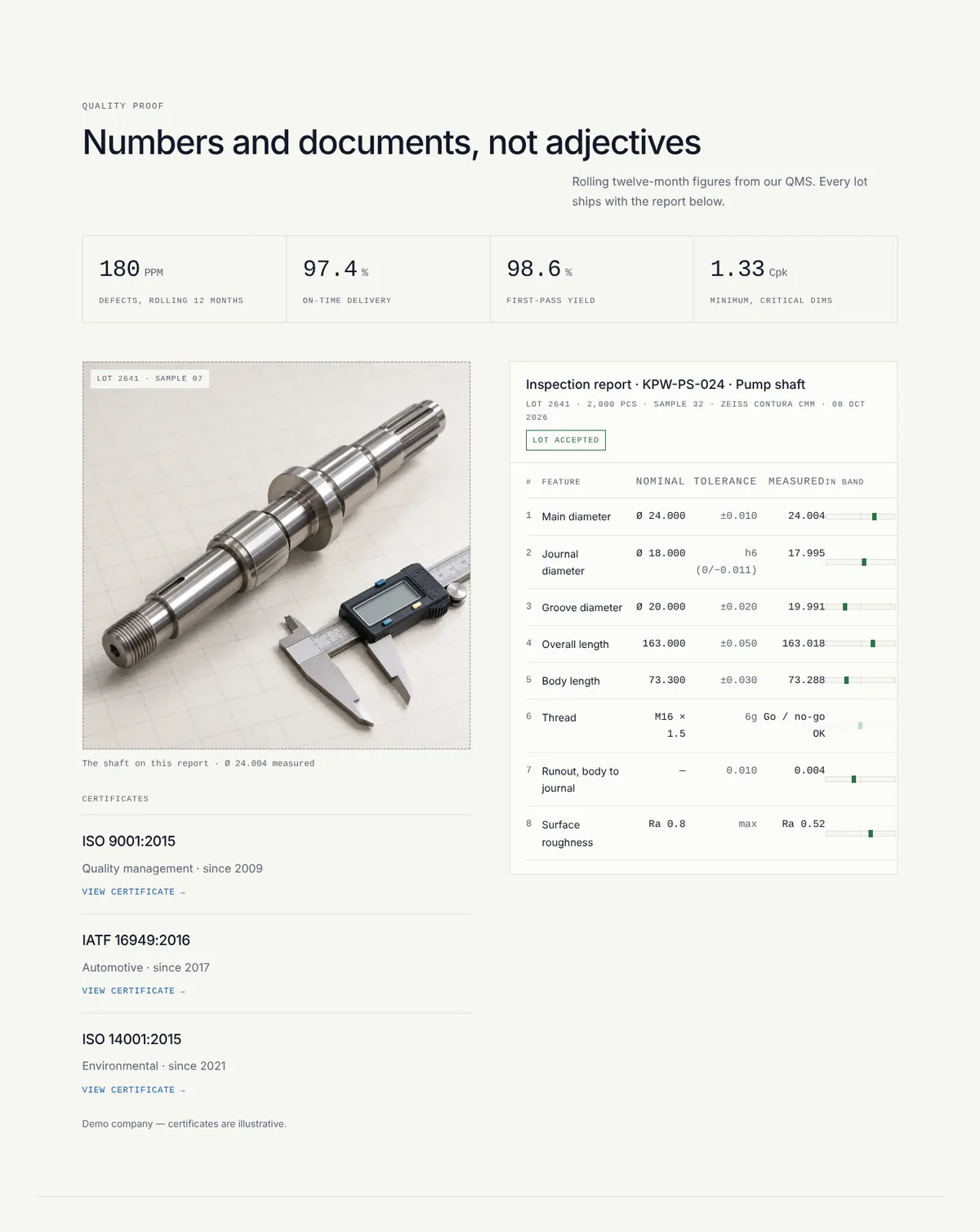
The centrepiece is an inspection report laid out the way a quality engineer expects: part, lot number, sample size, instrument (a Zeiss Contura CMM) and date, marked Lot accepted. Eight rows list each feature with its nominal size, tolerance and measured value. A small bar shows where the measurement sits inside the tolerance band, so you can see at a glance that nothing is near the edge.
For the manufacturer: your quality team’s everyday paperwork becomes your strongest sales material, and serious buyers qualify themselves.
Step 08
What it costs at the buyer’s door
An overseas buyer doesn’t compare your ex-works price with their local supplier. They compare the price at their door. So the export section builds it for them, using the part and quantity from the estimate.
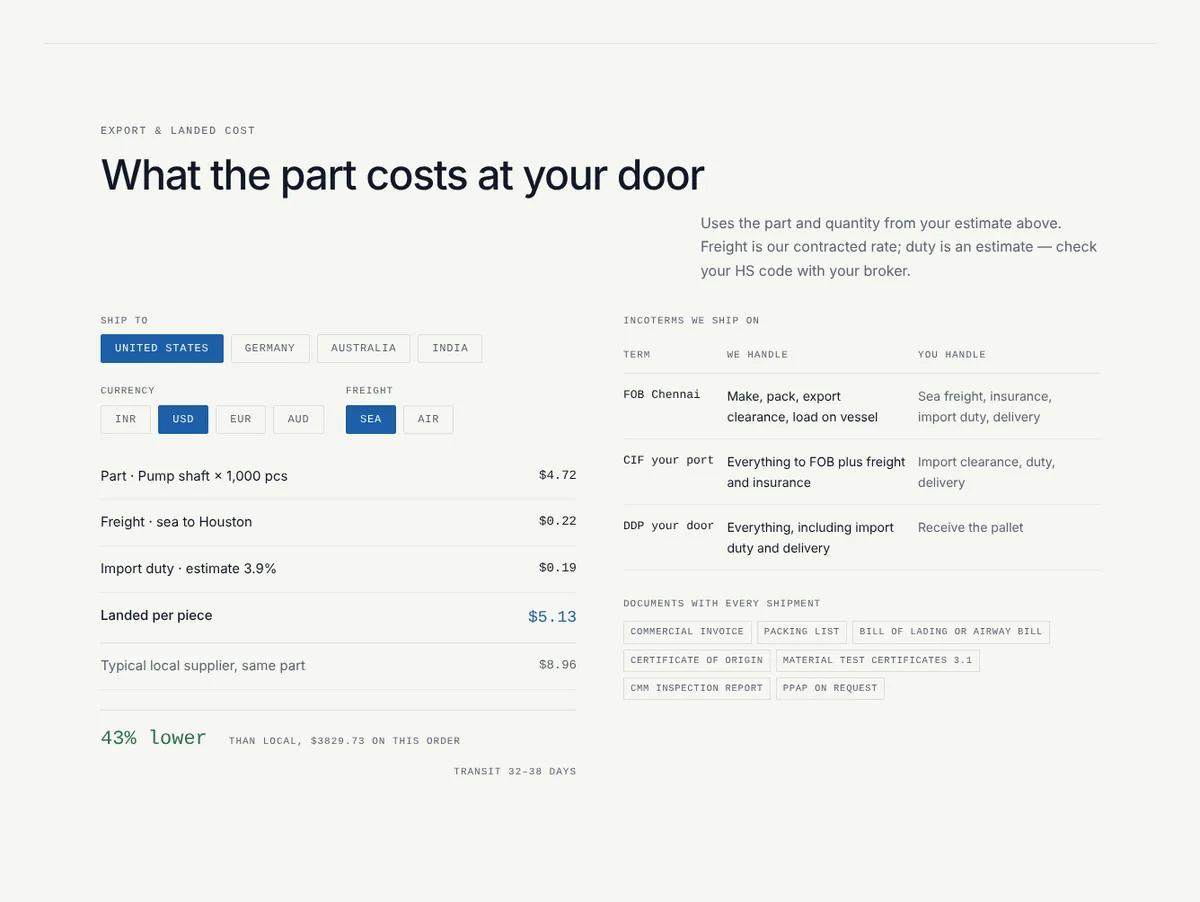
The buyer picks where they are (United States, Germany, Australia or India), a currency (INR, USD, EUR or AUD) and sea or air. The calculator shows the part price, freight, an estimated import duty and the landed price per piece, compared with a typical local supplier for the same part: in this example, 43% lower, with sea transit of 32–38 days.
Next to it, the three Incoterms the factory ships on (FOB Chennai, CIF your port, DDP your door) are explained in plain words: what the factory handles and what the buyer handles. Below that is the list of documents that ship with every order, from the commercial invoice to the CMM report. The duty line is clearly labelled as an estimate, with a note to check the HS code with a customs broker.
For the manufacturer: overseas buyers can make the business case internally without asking you for a freight quote first, which shortens export deals by weeks.
Step 09
Batch tracking that ends the “any update?” email
Every order gets its own page. The demo shows order KPW-26-0918: 2,000 pump shafts for a buyer in Houston, currently In packing. A vertical timeline lists each stage with its date: order confirmed, material in (with the heat number), machining 2,000 of 2,000, inspection with the CMM report, packing into eight cartons, and the shipping date with the container number.
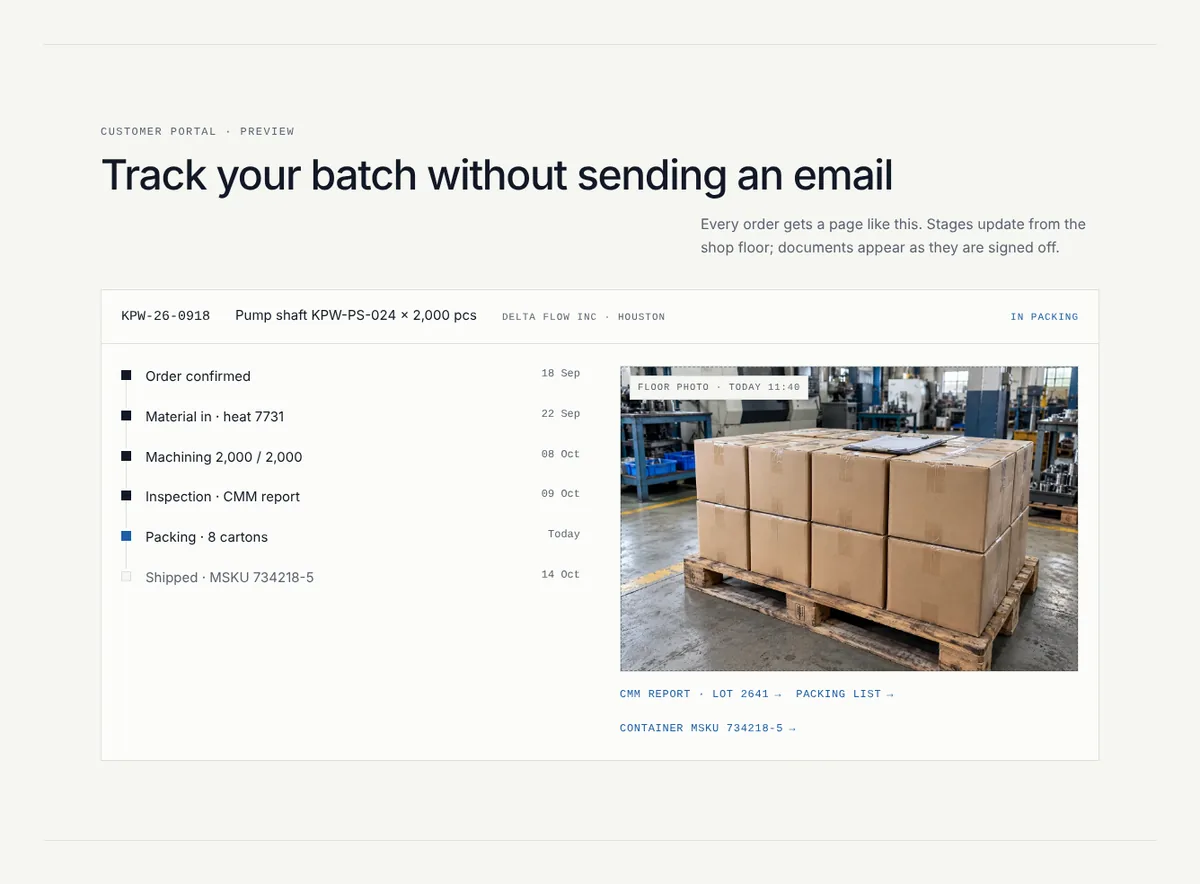
Next to the timeline is a photo from the shop floor taken that day, and links to the CMM report, packing list and container tracking. The buyer can see their parts exist without asking anyone.
For the manufacturer: fewer status emails and calls, calmer first orders, and a much higher chance the buyer comes back for the second one, which is where manufacturers make their money.
Step 10
Case studies with numbers, and an engineer at the end
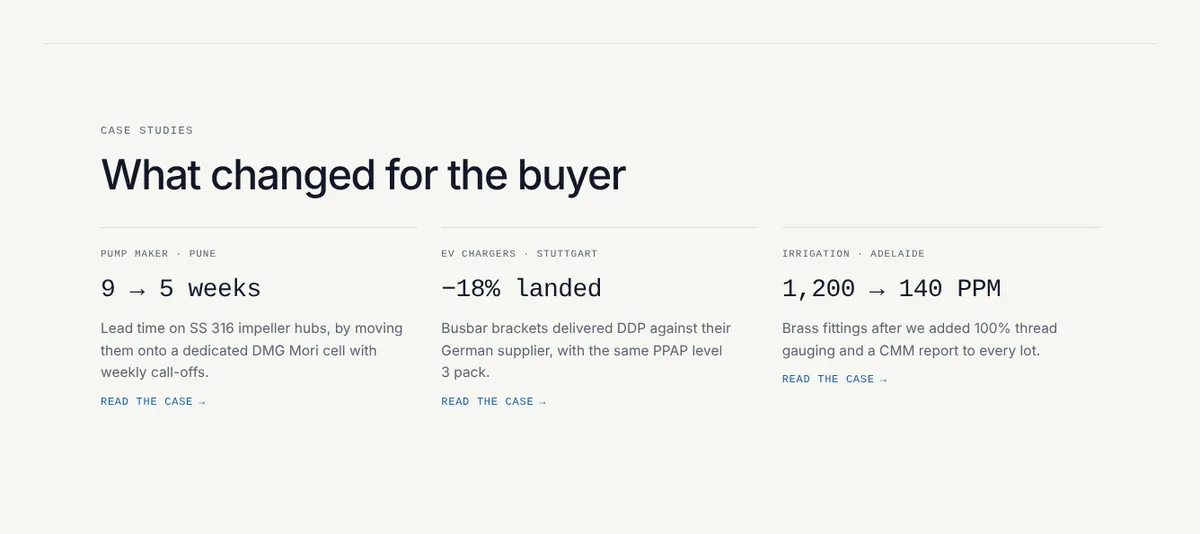
Near the end, three short case studies each lead with a single number: a pump maker’s lead time cut from 9 to 5 weeks, an EV charger company’s landed cost down 18%, and an irrigation company’s defects cut from 1,200 to 140 PPM. Each says in one sentence what changed to get there.
The page ends with “Send the drawing. Get a firm quote in 24 hours.” The person who replies is the engineer who runs the cell that would make the part, not a salesperson. The form is already filled in with the part, quantity and tolerance from the estimate. Two small touches matter a lot to overseas buyers: the engineers’ hours are shown converted into the visitor’s own time zone, and the factory offers to sign the buyer’s NDA first, before any drawing is sent.

For the manufacturer: more of the buyers who reach the bottom of the page actually send a drawing, and the drawings arrive with the details your engineers need.
Step 11
It works on a phone
Buyers often first see a supplier’s link in a WhatsApp message or an email on their phone. On a phone, the menu shrinks to the logo and one button, Get an estimate. The estimate, price-break chart, capacity grid and tour all stack into one column, and the inspection report scrolls sideways inside its own box so no column is lost.

For the manufacturer: the first impression holds up wherever the link is opened, and a buyer can get a price between meetings.
At a glance
The psychology at a glance
Every principle used on the site, where it shows up, and what it does for the buyer.
| Principle | Where it’s used | What it does |
|---|---|---|
| Loss aversion | Five questions answered in order | Removes reasons to say no |
| Processing fluency | Technical drawing in the hero | Feels familiar and credible |
| Precise numbers | Tolerances, sizes, finishes | Claims read as facts |
| Anchoring | Price-break chart from 100 pcs | Bigger orders look worth it |
| Honest scarcity | Booked load and next free slot | A real reason to order now |
| Labor illusion | Six-stop factory tour | Price feels justified |
| Authority | Inspection report and certificates | Trust in the quality |
| Framing | Landed cost next to local price | The right comparison, done for them |
| Cognitive dissonance | Batch tracking page | Calm after the first order |
| Fogg Behavior Model | Pre-filled form, local hours, NDA first | More drawings actually sent |
Your turn
Steal this for your own factory website
You don’t need a full rebuild to use these. Most can be added to the site you have.
- Write down the five questions your buyers ask in the first email, and answer each on your homepage.
- Replace every adjective in your capabilities with a number: tolerance, size, finish, materials, machine count.
- Publish a price range for two or three typical parts, with prices at three order sizes.
- Show your next free week per process, even if you update it by hand every Monday.
- Put one real inspection report on the site, with the customer’s details removed.
- Show photos of each step from raw material to packing, with the check done at each one.
- For export, show one landed-cost example per main market and explain FOB, CIF and DDP in plain words.
- Offer to sign the buyer’s NDA before they send a drawing, and say so near the form.
Questions
Questions people ask
How much does a manufacturing website like this cost?
It depends on what it connects to. A site with fixed price examples and a quote form is very different from one where the estimate and capacity come from your ERP and machine monitoring. Send me what you make and how you quote, and I’ll give you a fixed price before any work starts.
Can the instant estimate use our real pricing?
Yes. It works from your own price breaks and multipliers for material, finish and tolerance, the same logic your estimator uses in a spreadsheet. It shows a range, and every firm price is still checked by your engineer.
Won’t competitors see our prices?
They see ranges for sample parts, not your full price list. Most buyers already share quotes between suppliers, so a range costs you little, while being the only supplier with a price on the page wins you the first conversation.
Can live capacity connect to our machines or ERP?
Usually, yes. If you use machine monitoring or an ERP with an export or API, the board can update every shift. If not, it can be updated by hand once a week, which is still far more than buyers get elsewhere.
Will a site like this rank on Google?
The structure helps: a page per process and material, real specifications, case studies and fast pages are what industrial buyers search for. Ranking also depends on your competition and on building links and content over time, so I plan that with you.
Are the photos and certificates in the demo real?
No. Kestrel is a fictional company. The photos are illustrative and the certificates, figures and customers are placeholders. For a real client, everything is replaced with your own floor, documents and numbers before launch.
Further reading
Sources and further reading
The principles above come from published research in psychology and behavioural economics. If you want to read further:
- Kahneman, D. & Tversky, A. (1979). Prospect theory: an analysis of decision under risk. Econometrica.
- Reber, R., Schwarz, N. & Winkielman, P. (2004). Processing fluency and aesthetic pleasure. Personality and Social Psychology Review.
- Schindler, R. M. & Yalch, R. F. (2006). It seems factual, but is it? Effects of using sharp versus round numbers in advertising claims. Advances in Consumer Research.
- Tversky, A. & Kahneman, D. (1974). Judgment under uncertainty: heuristics and biases. Science.
- Cialdini, R. B. (1984). Influence: The Psychology of Persuasion.
- Buell, R. W. & Norton, M. I. (2011). The labor illusion: how operational transparency increases perceived value. Management Science.
- Tversky, A. & Kahneman, D. (1981). The framing of decisions and the psychology of choice. Science.
- Festinger, L. (1957). A Theory of Cognitive Dissonance.
- Fogg, B. J. (2009). A behavior model for persuasive design. Proceedings of Persuasive 2009.