Case study · Real estate website
A property websitethat shows the full priceand the sunlight
Banyan Court is a website I designed and built as a demo for a new apartment project in Kolkata. This is the full walkthrough: what each section does, how a homebuyer uses it, and the psychology that turns a nervous first-time buyer into a booked site visit.

In one minute
- The site is built around the four fears of someone buying a flat that isn’t built yet: hidden charges, delays, a weak builder and a dark, cramped home.
- Buyers choose a flat from a drawing of the building and drag the sun to see when it gets light.
- Every flat shows its all-in price, all nine charges, and a monthly EMI next to it.
- Construction progress is shown against the dates promised to RERA, updated every month.
- The builder shows every past project, including the late one, and NRI buyers get a desk in their own time zone.
Who this is for
Real estate developers, builders and channel partners selling new or under-construction homes, from a single tower to a township.
Every idea here works on an existing site too. There’s a checklist at the end.
Jump to the checklistOn this page
- Start with what the buyer is afraid of
- A first screen that leads with light and a real price
- Let them live a day in the flat before they visit
- Sizes in the unit the law uses
- Choose your flat from the building itself
- One price, with all nine charges shown
- What it costs each month
- Progress against the promised dates
- The neighbourhood, for the life they actually lead
- A track record that includes the late one
- An NRI desk and a documents room
- A visit booking that respects their time
- It works on a phone
- The psychology at a glance
- Steal this for your own project website
- Questions people ask
A homebuyer looking at a new project online is not browsing for fun. They are about to spend most of their savings, plus twenty years of EMIs, on a flat they can’t walk into yet. They are looking for reasons to trust a builder they have never met.
Most real estate websites give them very little. A render at sunset, a list of amenities, a price that says “onwards”, and a form that passes their phone number to a call centre. So the buyer calls five projects, gets five sales pitches, and decides on gut feel at a site visit.
With Banyan Court I set one rule: every fear a buyer has must be answered with something they can check. Below is each section in the order you meet it, with the screenshot, what it does and the psychology behind it.
Banyan Court is a design demo. The project, builder, photos, prices, tax rates, RERA number and dates are fictional placeholders, and for a real client they are replaced with the real ones before launch. Some screenshots here leave out the photos to keep the focus on the parts that work. The design decisions and the psychology are what this post is about.
Step 01
Start with what the buyer is afraid of
Buying a flat in a building that doesn’t exist yet is the biggest purchase most families will make, and they are making it on trust. They have heard the stories from relatives and colleagues: the price that grew by ₹8 lakh at registration, the possession date that slipped by three years, the builder who disappeared, the “east-facing” flat that never sees the sun.
So before designing anything I wrote down what a buyer is really worried about. It came down to four fears:
- What will I actually pay? Not the base price, the final amount.
- Will it be finished on time?
- Can I trust this builder?
- Will I like living there? Light, air, space, the commute, the school run.
Most real estate websites answer none of them. They show a render of the building at sunset, a list of 40 amenities, “starting from ₹65 lakh*” and a form that hands your number to a call centre. Banyan Court answers each fear with something the buyer can check for themselves, and each answer is a section of the site.
For the developer: buyers who would have called five projects to ask the same questions get the answers on your site, and the ones who book a visit arrive already sure about the basics.
Step 02
A first screen that leads with light and a real price
The headline is a promise about how the home will feel: “Morning light in every room.” Behind it, room photos change slowly from the living room to the lounge, bedroom and kitchen, with the room’s size, direction and floor in a small card. The two buttons are Choose your flat and Step inside. There is no “Enquire now”.
Under the photo sits a white strip with four facts that most projects hide until the second meeting:
- ₹71.16 L for a 2 BHK, all-in, nothing added later
- Dec 2028 possession, with the structure 3 weeks ahead
- 37 of 192 flats still available
- The RERA registration number, right there on the first screen
For the developer: the first screen filters out people who can’t afford the project and builds trust with the ones who can, before anyone has spoken to sales.
Step 03
Let them live a day in the flat before they visit
Before any floor plan, the site shows “A day inside a Banyan Court home.” It follows the light through a 3 BHK on floor 11: breakfast in east light at 7:10 am, the kitchen window at 8:30, an afternoon nap at 2:00, tea on the balcony at 6:30, and a quiet evening at 9:00 because the towers face the park, not the road. Each photo has the time, the room and its size.
Next is “Walk through every room”, a curved gallery you drag like turning your head, with each room’s size and when it gets the sun, like Master bedroom, 13′ × 12′, morning sun from 6:40 am.
For the developer: buyers form an emotional attachment to the project from their sofa, which is what usually only happens in the sample flat.
Step 04
Sizes in the unit the law uses
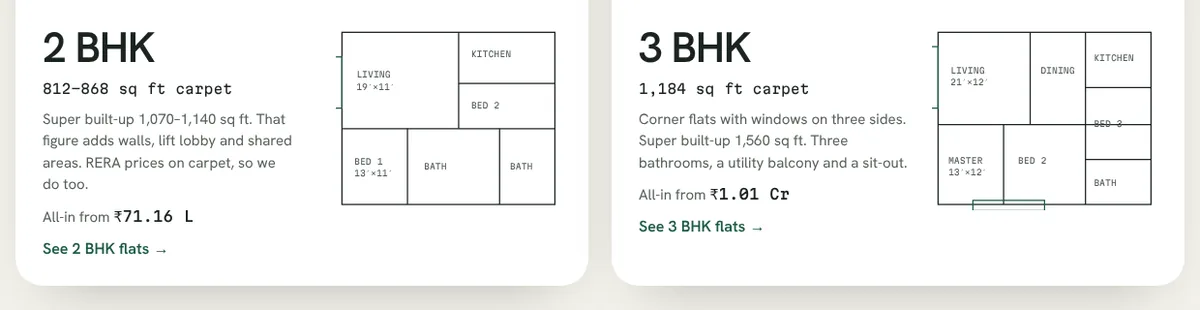
The two home types each get one card: a floor plan with room sizes, how many are left, and the all-in starting price. The size shown first is the carpet area, the floor you actually live on, which is what RERA requires builders to sell by. The bigger super built-up figure is there too, with one plain sentence on why it is bigger.
Step 05
Choose your flat from the building itself
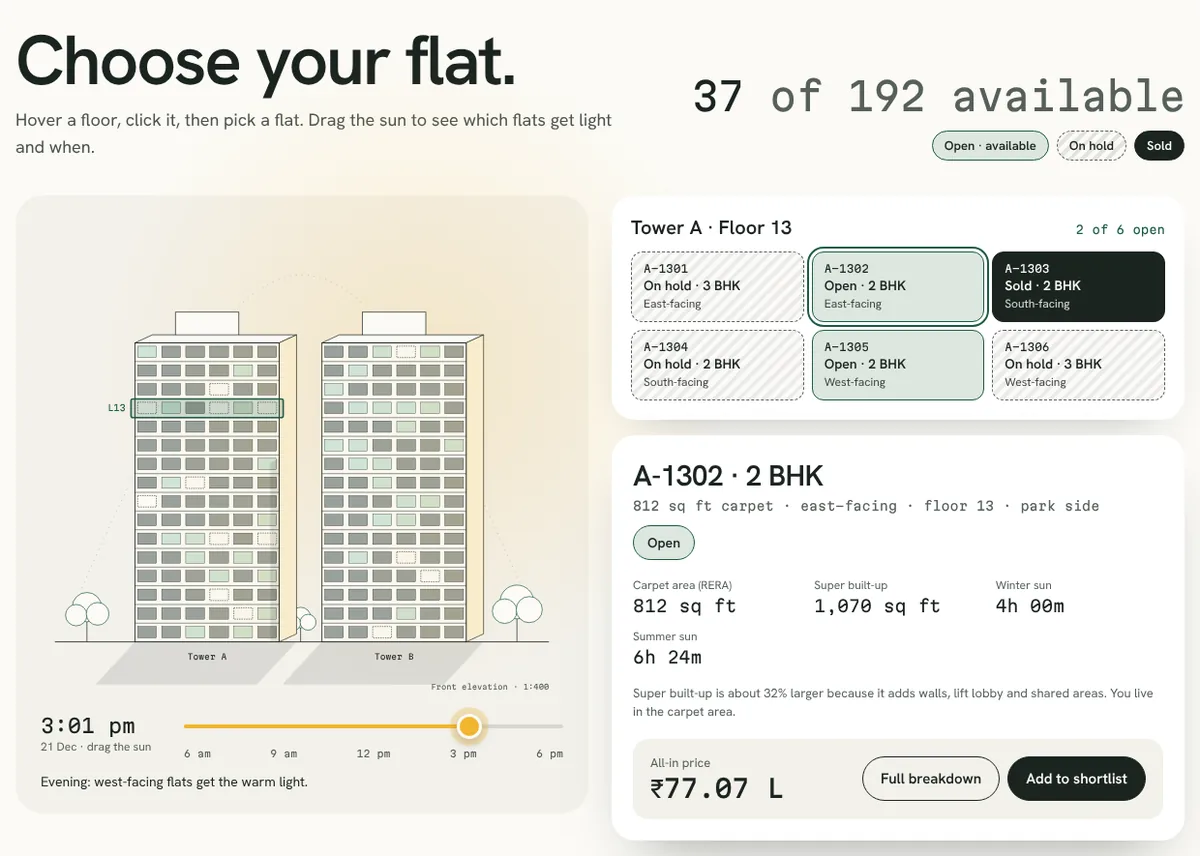
This is the heart of the site. Instead of a list of flats, the buyer sees a drawing of the two towers. Hover over a floor and it lights up; click it and its six flats appear as cards, each marked Open, On hold or Sold, with its size and the direction it faces.
Under the drawing is a sun slider. Drag it from 6 am to 6 pm on the shortest day of the year and the windows on the drawing light up or fall into shade. The chosen flat then shows its carpet area, super built-up area and hours of sun in winter and summer, followed by the all-in price, a link to the full breakdown and an Add to shortlist button.
For the developer: buyers arrive at the site visit asking for a specific flat by number, which makes the visit shorter and the decision faster.
Step 06
One price, with all nine charges shown
Click Full breakdown and the buyer sees the total in very large type, ₹77.07 L, with the line “This is the full amount. Nothing is added at registration.” Next to it is every charge: base price, floor rise, preferred location charge, covered parking, GST, stamp duty, registration, maintenance deposit and club membership. Each one has its rate in a small line underneath, and the total sits in a dark bar at the bottom.
Pick another flat in the picker and the whole breakdown updates. A note says the GST, stamp duty and registration rates are demo values to be checked before launch.
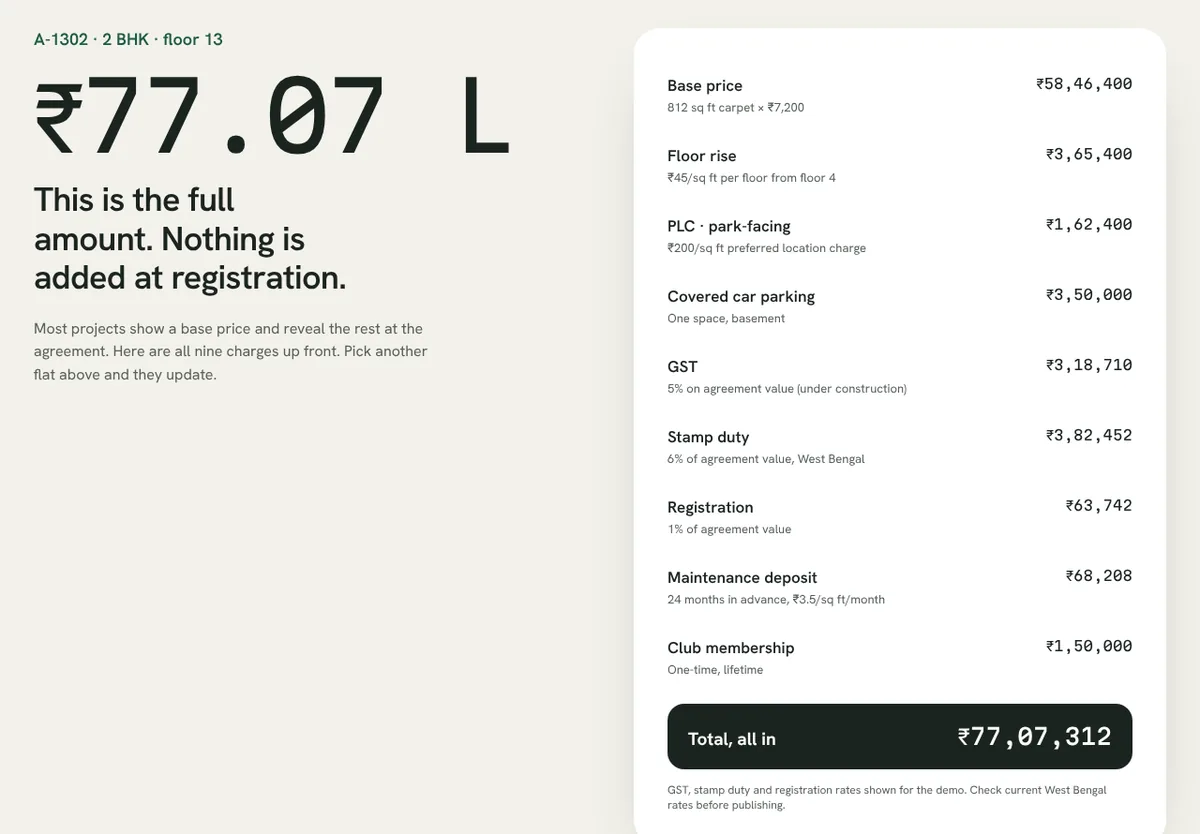
For the developer: fewer deals fall apart at the agreement stage, and fewer angry reviews and RERA complaints about charges nobody mentioned.
Step 07
What it costs each month
Most families don’t think in lakhs; they think in monthly payments. So the next section turns the total into an EMI. Three sliders set the down payment, interest rate and tenure, and the card updates live: ₹53,509 per month for A-1302 with 20% down at 8.5% over 20 years.
Two lines under it answer the next questions before they are asked: the monthly income a bank will want to see (₹1,07,017) and the pre-EMI interest until possession (about ₹24,021 a month). Below that are the banks that have approved the project and the full construction-linked payment plan: what share is due at each stage, how much it is, and when, with future stages shown as dotted forecasts.
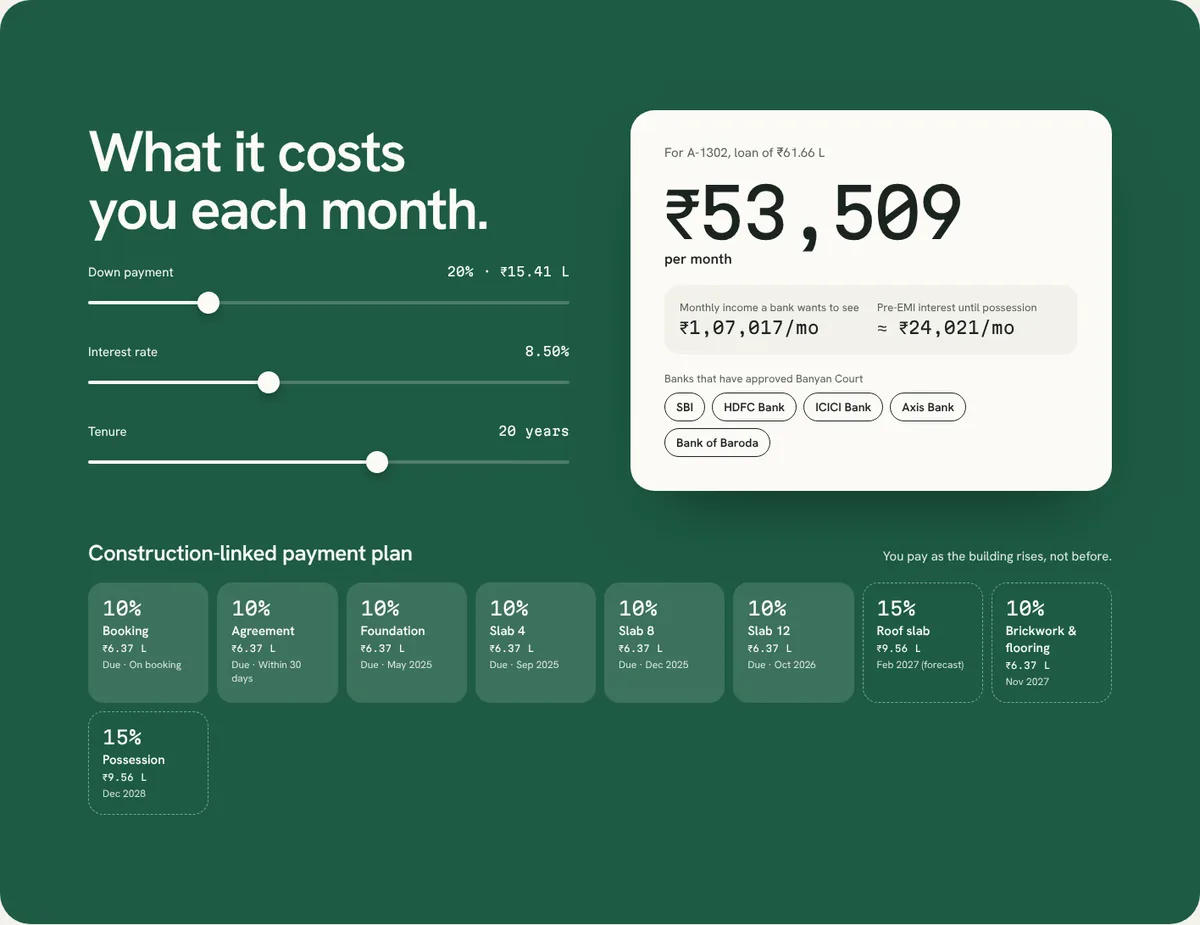
For the developer: the people who book a visit already know they can afford it, so your sales team spends its time on real buyers.
Step 08
Progress against the promised dates
The headline is the boldest line on the site: “Don’t trust us. Check us, every month.” A large site photo has month tabs from May to October; each month has its own photo and a one-line update like “Tower A slab 12 cast, 3 weeks ahead.”
Below it, each tower shows its progress by stage, and a promised vs actual timeline plots every milestone: the date promised to RERA as a hollow circle, the date it was actually done as a filled one, and future milestones as forecasts. The right-hand column reads 1 mo early or On track. A link goes to the RERA registration and its quarterly updates.
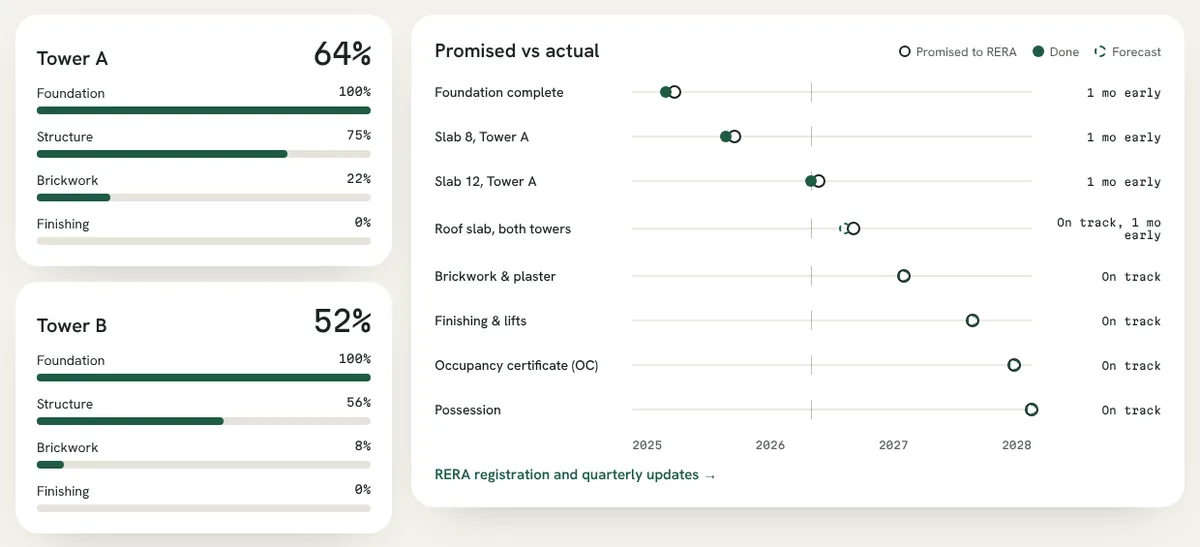
For the developer: existing buyers stop calling to ask about progress, and new buyers see delays, the biggest fear in Indian real estate, answered with data.
Step 09
The neighbourhood, for the life they actually lead
The neighbourhood section starts with real distances, not “close to everything”: “A 4-minute walk to the park. 11 minutes to school.” Three tabs change the list for a family with kids, a working couple or parents moving in, so a retired couple sees the hospital and the market first, and a family sees the school.
A dark card asks where you work. Pick Sector V, DLF IT Park, Park Street or Infosys and it shows the drive off-peak and in the 9 am rush, because buyers know the rush-hour number is the one that matters. Below this, “Life downstairs” shows four amenities with their real sizes and hours, not forty with none.
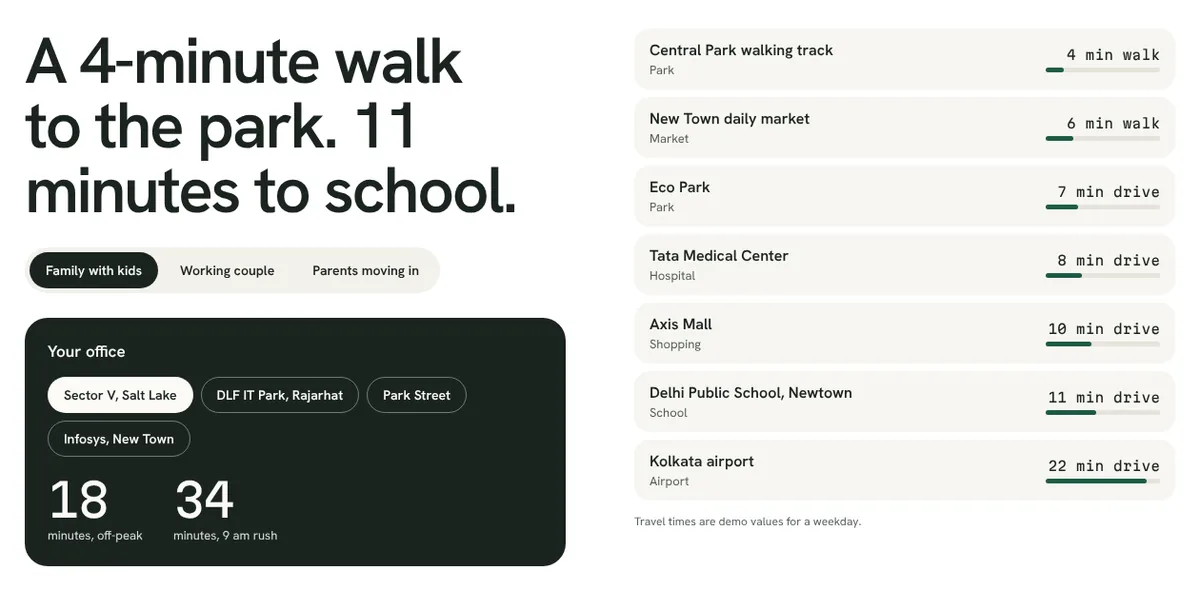
For the developer: the site sells the location to each type of buyer in their own terms, which a brochure can’t do.
Step 10
A track record that includes the late one
The builder section is titled “532 families already moved in.” It shows every recent project with the date promised and the date the keys were handed over. Two were early or on time. One, Sarani Lakeview, was three months late, and the card says so, with the reason: the Covid lockdown, and buyers paid no pre-EMI for the delay.
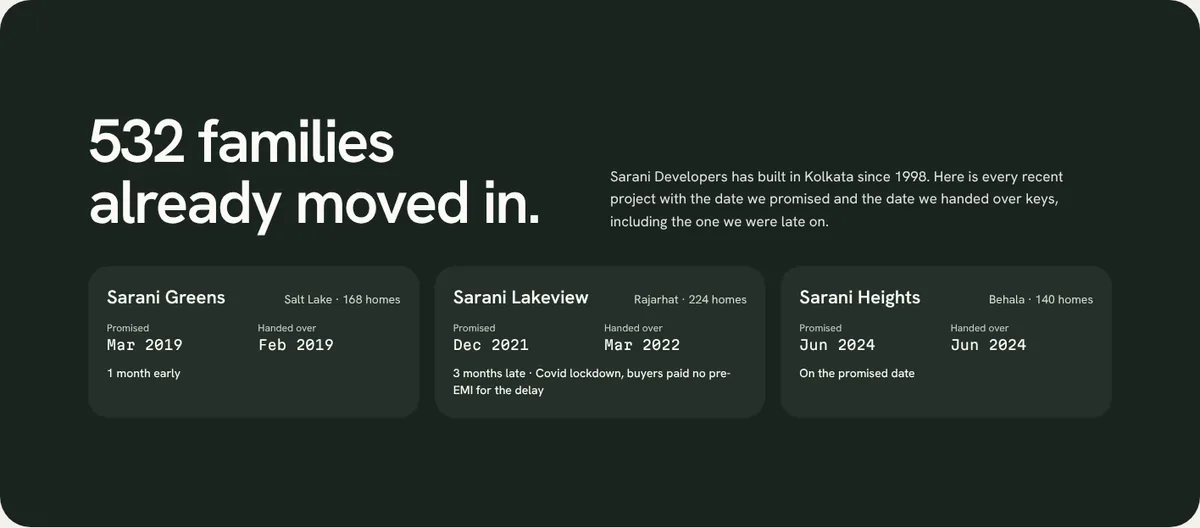
For the developer: the trust question is answered before the buyer looks you up online, and the one bad project is told in your words, not a stranger’s.
Step 11
An NRI desk and a documents room
Many buyers in Indian cities live abroad, and most project websites treat them as an afterthought. Banyan Court gives them their own section, “Buying from abroad?” They pick where they live (US East, UK, Australia, Singapore or the Gulf) and see video-visit slots in their own time with the IST time next to it. Five steps explain the whole process, from an NRI home loan to registering by power of attorney, followed by the documents they’ll need.
Next to it is “The documents room.” Every approval is listed in full, the RERA certificate, building plan sanction, land title summary, fire NOC, the sample agreement for sale and the bank approval letters, each with one line on what it means, like “The exact contract you will sign, to read before you pay anything.”
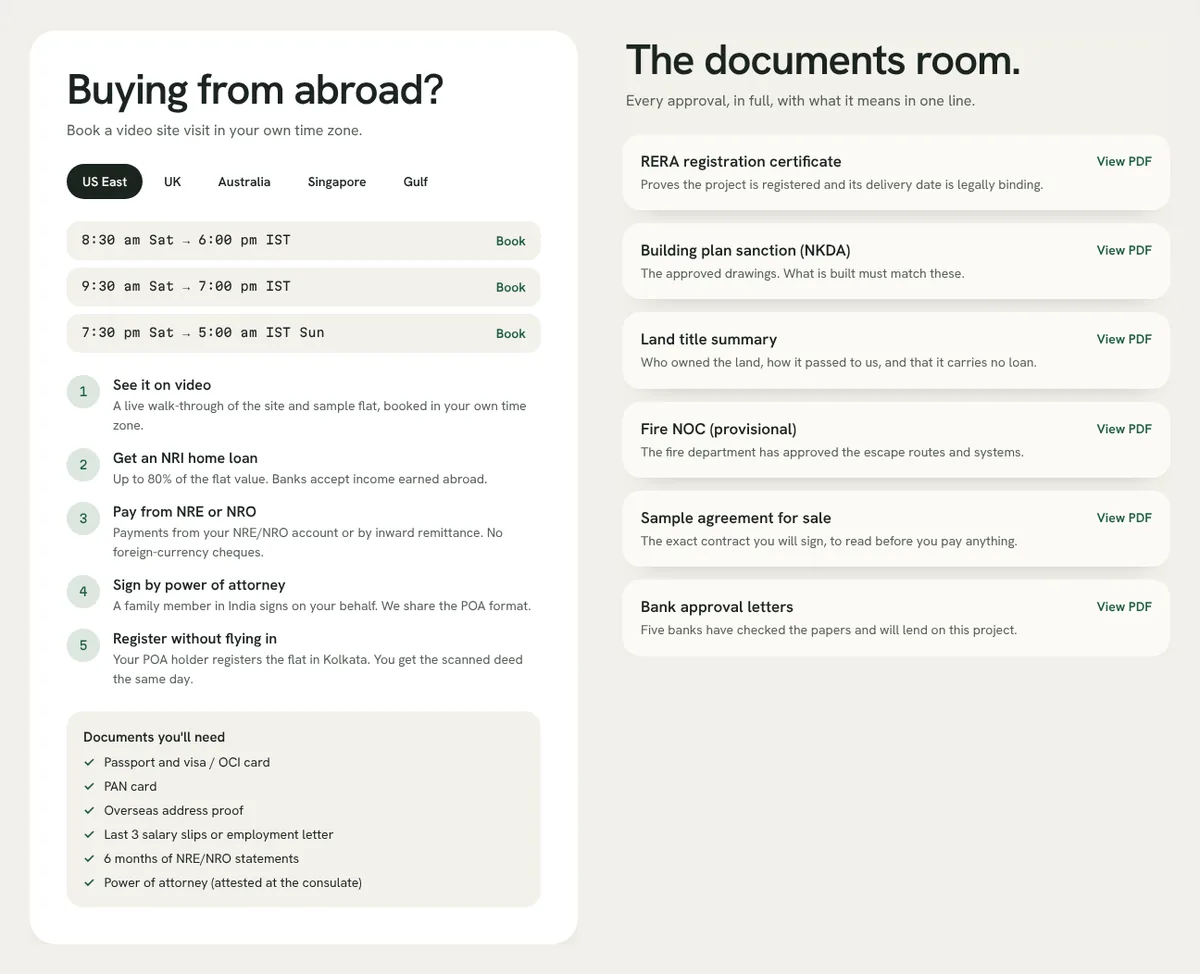
For the developer: NRI buyers, who often pay in full and decide for the whole family, get a process they can follow from abroad instead of waiting for their next trip home.
Step 12
A visit booking that respects their time
The site ends with “Come and stand in the light.” The form has a switch between a video visit and a site visit, and only three fields: name, WhatsApp number, and the flat they’re interested in, already filled in from the picker with its all-in price. The promise next to it matters as much as the form: “One person from our team calls you once, at the time you choose. No call centre.”
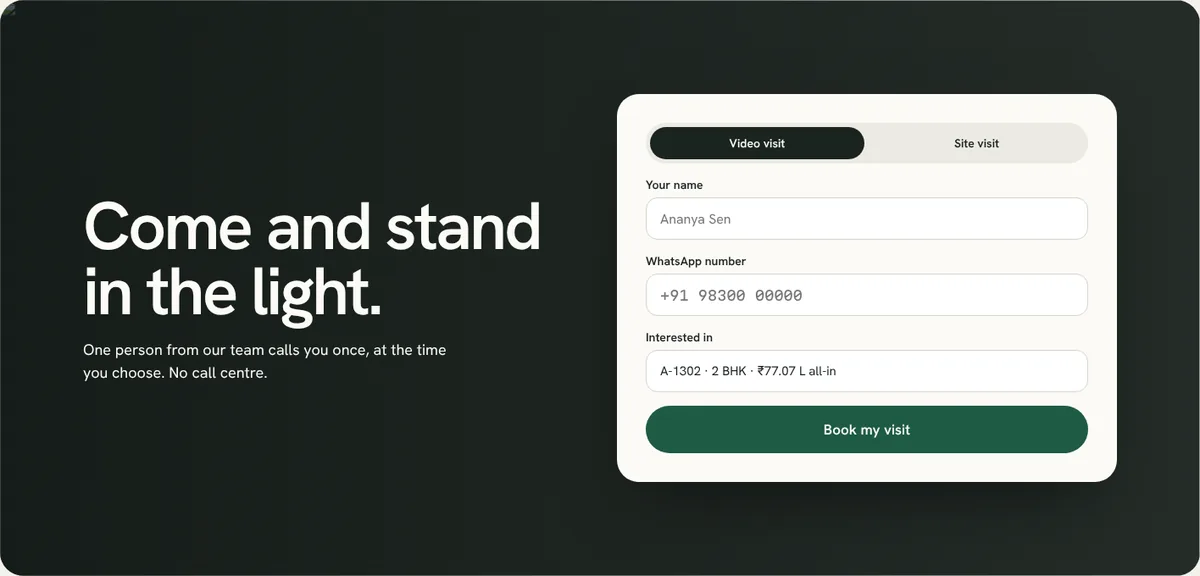
For the developer: more visitors book, and the leads come with the flat, budget and visit type already known.
Step 13
It works on a phone
Most property links are opened from WhatsApp or an Instagram ad, on a phone. On a small screen the towers, the flat cards, the price breakdown and the EMI sliders all stack into one column, and the sun slider is large enough to drag with a thumb.
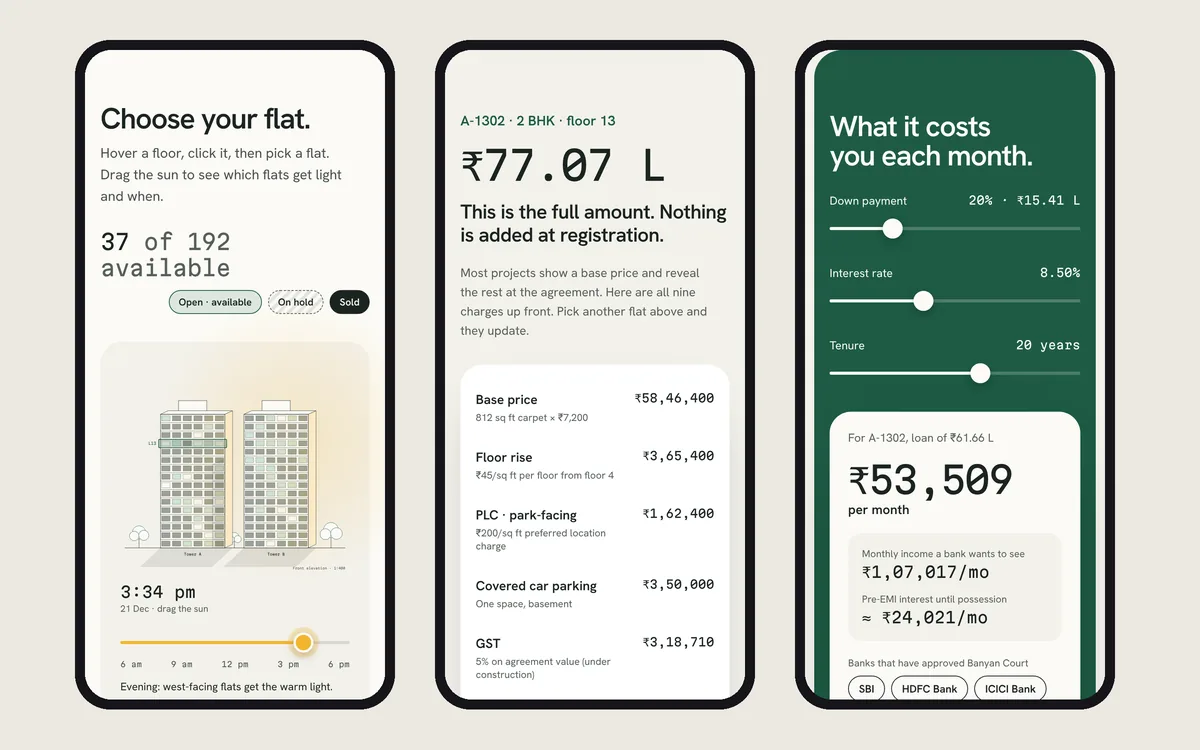
For the developer: the whole buying journey, from choosing a flat to booking a visit, works from the link someone forwarded on WhatsApp.
At a glance
The psychology at a glance
Every principle used on the site, where it shows up, and what it does for the buyer.
| Principle | Where it’s used | What it does |
|---|---|---|
| Ambiguity aversion | Four fears answered in order | Turns unknowns into numbers |
| Anchoring | All-in price on the first screen | No shocks later |
| Mental simulation | A day inside, room walk-through | The buyer pictures living there |
| Processing fluency | Carpet area explained in one line | The builder seems straight |
| IKEA effect | Choosing a flat from the building | The flat starts to feel theirs |
| Honest scarcity | Open, on hold and sold flats | Real reason to decide |
| Drip pricing, avoided | Nine charges, one total | Trust in the price |
| Pennies-a-day framing | EMI and income needed | Feels affordable and checkable |
| Operational transparency | Promised vs actual progress | Belief in the delivery date |
| Tailoring | Neighbourhood by type of family | The location fits their life |
| Two-sided message | The late project, explained | The whole record is believed |
| Psychological distance | NRI slots in their time zone | Buying from abroad feels doable |
| Fogg Behavior Model | Three fields, one call | More visits booked |
Your turn
Steal this for your own project website
You don’t need a full rebuild to use these. Most can be added to the site you have.
- Show the all-in price for at least one real flat, with every charge listed and its rate.
- Lead with carpet area, and explain super built-up in one sentence.
- Publish which flats are open, on hold and sold, even if you update it by hand each week.
- Add an EMI example and the monthly income a bank would want to see.
- Post one dated site photo every month, next to the dates you promised RERA.
- List every past project with the promised and actual handover date, and explain any delay.
- Put the sample agreement and the approvals on the site, each with one line on what it means.
- Show NRI visit slots in their time zone, and promise one call at a time the buyer chooses.
Questions
Questions people ask
How much does a real estate website like this cost?
It depends on how much is live. A site with a fixed inventory you update by hand is very different from one where the flat picker, prices and progress come from your sales software or a spreadsheet. Send me your project and how you sell, and I’ll give you a fixed price before any work starts.
Can the flat picker connect to our real inventory?
Yes. It can read from your CRM, ERP or a shared spreadsheet, so a flat marked on hold or sold by your sales team changes on the site within minutes. If you don’t have a system, it can be updated by hand from a simple admin page.
Won’t showing the all-in price scare buyers away?
It filters out people who could never afford the project, which saves your team time. The buyers who stay trust the number, and fewer of them walk away at the agreement stage when the real total appears.
What if our project is running late?
Then the progress section is even more important, because buyers will find out anyway. Showing the delay, the reason and the new date with monthly photos keeps far more trust than silence, and it cuts the calls your team gets asking for updates.
Will a site like this rank on Google?
The structure helps: pages for each home type, the neighbourhood and the NRI process, real specifications and fast pages are what buyers search for. Ranking also depends on your competition and on content and links built over time, so I plan that with you.
Are the photos, prices and RERA number in the demo real?
No. Banyan Court and Sarani Developers are fictional. The photos are illustrative stock images, and the prices, tax rates, RERA number and dates are placeholders. For a real client, everything is replaced with your own project, documents and numbers before launch.
Further reading
Sources and further reading
The principles above come from published research in psychology and behavioural economics. If you want to read further:
- Ellsberg, D. (1961). Risk, ambiguity, and the Savage axioms. Quarterly Journal of Economics.
- Kahneman, D. & Tversky, A. (1979). Prospect theory: an analysis of decision under risk. Econometrica.
- Tversky, A. & Kahneman, D. (1974). Judgment under uncertainty: heuristics and biases. Science.
- Elder, R. S. & Krishna, A. (2012). The “visual depiction effect” in advertising: facilitating embodied mental simulation through product orientation. Journal of Consumer Research.
- Kahneman, D., Knetsch, J. L. & Thaler, R. H. (1990). Experimental tests of the endowment effect and the Coase theorem. Journal of Political Economy.
- Reber, R., Schwarz, N. & Winkielman, P. (2004). Processing fluency and aesthetic pleasure. Personality and Social Psychology Review.
- Norton, M. I., Mochon, D. & Ariely, D. (2012). The IKEA effect: when labor leads to love. Journal of Consumer Psychology.
- Worchel, S., Lee, J. & Adewole, A. (1975). Effects of supply and demand on ratings of object value. Journal of Personality and Social Psychology.
- Blake, T., Moshary, S., Sweeney, K. & Tadelis, S. (2021). Price salience and product choice. Marketing Science.
- Central Consumer Protection Authority, India (2023). Guidelines for Prevention and Regulation of Dark Patterns, 2023.
- Gourville, J. T. (1998). Pennies-a-day: the effect of temporal reframing on transaction evaluation. Journal of Consumer Research.
- Buell, R. W. & Norton, M. I. (2011). The labor illusion: how operational transparency increases perceived value. Management Science.
- Buell, R. W., Kim, T. & Tsay, C.-J. (2017). Creating reciprocal value through operational transparency. Management Science.
- Noar, S. M., Benac, C. N. & Harris, M. S. (2007). Does tailoring matter? Meta-analytic review of tailored print health behavior change interventions. Psychological Bulletin.
- Eisend, M. (2006). Two-sided advertising: a meta-analysis. International Journal of Research in Marketing.
- Cialdini, R. B. (1984). Influence: The Psychology of Persuasion.
- Trope, Y. & Liberman, N. (2010). Construal-level theory of psychological distance. Psychological Review.
- Fogg, B. J. (2009). A behavior model for persuasive design. Proceedings of Persuasive 2009.