Case study · Coaching institute website
A coaching websitethat shows the median,not just the topper
Axiom Academy is a website I designed and built as a demo for a JEE and NEET coaching institute in Kolkata. This is the full walkthrough: what each section does, how students and parents use it, and the psychology that turns years of distrust in coaching ads into a booked demo class.
In one minute
- Coaching ads all show the same toppers, so students and parents have stopped believing them. This site leads with the median of the whole batch.
- Toppers are still there, but only students who studied at least a full year, with partly masked roll numbers.
- A free 10-question test inside the page gives a chapter-wise result and a suggested batch, with no sign-up.
- Batches show real seats left, and a sample week, the faculty and the weekly progress report show what joining actually looks like.
- The full two-year fee, the scholarship and a plain-words refund policy are on the page.
Who this is for
Coaching institutes for JEE, NEET, CA, UPSC and other exams, tuition centres, and any education business selling to students and parents together.
Every idea here works on an existing site too. There’s a checklist at the end.
Jump to the checklistOn this page
- Two people decide, and both have stopped believing ads
- Lead with the median, not the topper
- Every student, one chart each, and toppers with proof
- A free test inside the page
- Fill four bubbles, see real seats
- A real week, and doubts in 11 minutes
- The teachers you meet are the ones who teach
- Progress the student and parent can both see
- The whole fee, and a refund policy in plain words
- For students from outside Kolkata
- Sit in a real class, or talk to a teacher
- It works on a phone
- The psychology at a glance
- Steal this for your own institute’s website
- Questions people ask
Every coaching institute advertises the same way: rows of toppers’ photos, ranks in big red numbers, and “100% selection”. Students and parents have seen it so often that they no longer believe it, and some have seen the same topper claimed by several institutes at once. What they actually want to know is how a normal student does, who will teach, and what it really costs.
With Axiom I set one rule: every claim must come with something a student or parent can check, starting with the result of the whole batch. Below is each section in the order you meet it, with the screenshot, what it does and the psychology behind it.
Axiom Academy is a design demo. The institute, students, results, faculty, fees and hostels are fictional placeholders, and for a real client they are replaced with the real ones before launch. The test questions were written for the demo. The design decisions and the psychology are what this post is about.
Step 01
Two people decide, and both have stopped believing ads
Choosing a JEE or NEET coaching institute is a decision made by two people. A 16- or 17-year-old who has to sit in the class for two years, and a parent who pays several lakh rupees for it. Both have seen the same thing for years: hoardings and full-page ads covered in toppers’ photos, “100% selection”, and sometimes the same student claimed by three institutes at once.
So I wrote down what they actually want to know, in the order they ask it:
- Do your results hold up, or is it the same toppers every institute claims?
- Is my child ready, and which batch fits?
- Who will actually teach, and will doubts get answered?
- How will we know if it’s working, month by month?
- What is the full cost, and what if it doesn’t work out?
Axiom’s site answers each one in its own section, labelled Q1 to Q5 like an exam paper.
For the institute: the institute stands out in a market where every competitor sounds the same, and families arrive at the counselling call already trusting the numbers.
Step 02
Lead with the median, not the topper
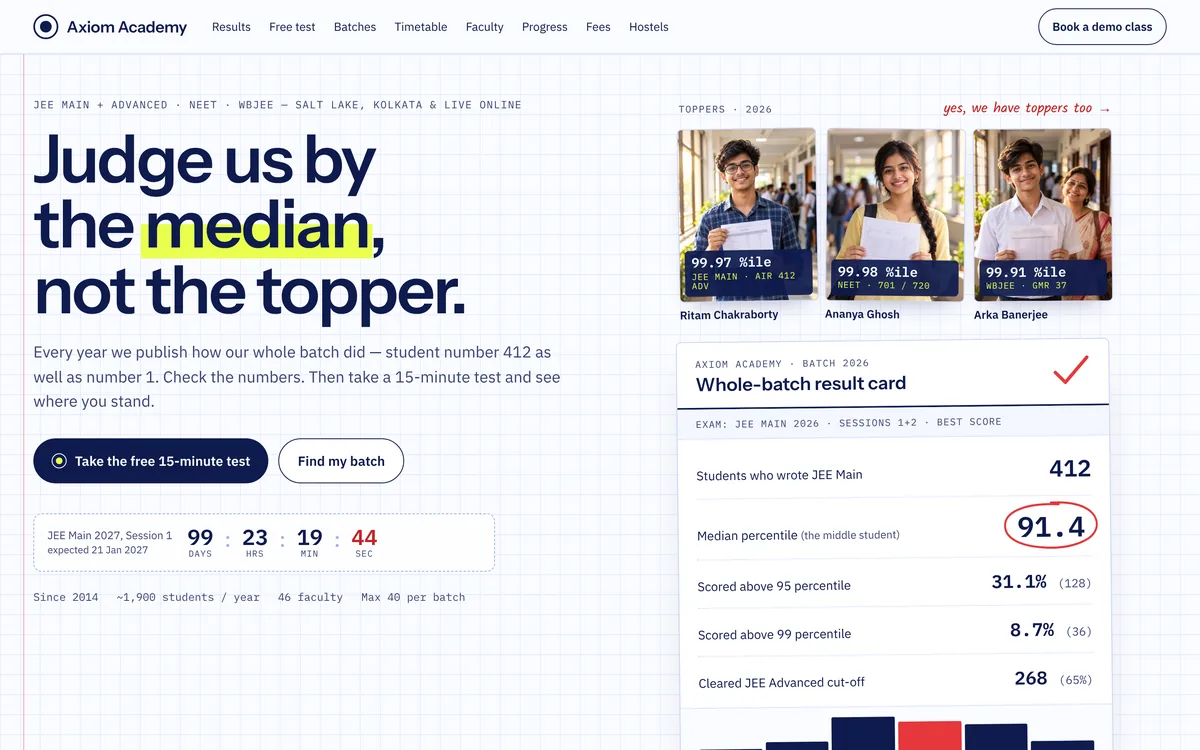
The headline says the opposite of every coaching ad: “Judge us by the median, not the topper.” The word median is highlighted in yellow, like a student marking their notes. Under it: “Every year we publish how our whole batch did — student number 412 as well as number 1.”
On the right is a whole-batch result card: 412 students wrote JEE Main, the median percentile was 91.4 (circled in red pen), 31.1% scored above 95, 8.7% above 99, and 268 cleared the JEE Advanced cut-off, with a small chart of the whole batch. Above it, three toppers still appear, with a handwritten note: “yes, we have toppers too.” A live countdown to JEE Main sits under the buttons.
For the institute: the institute owns a claim no competitor can copy without publishing their own median, which most won’t.
Step 03
Every student, one chart each, and toppers with proof
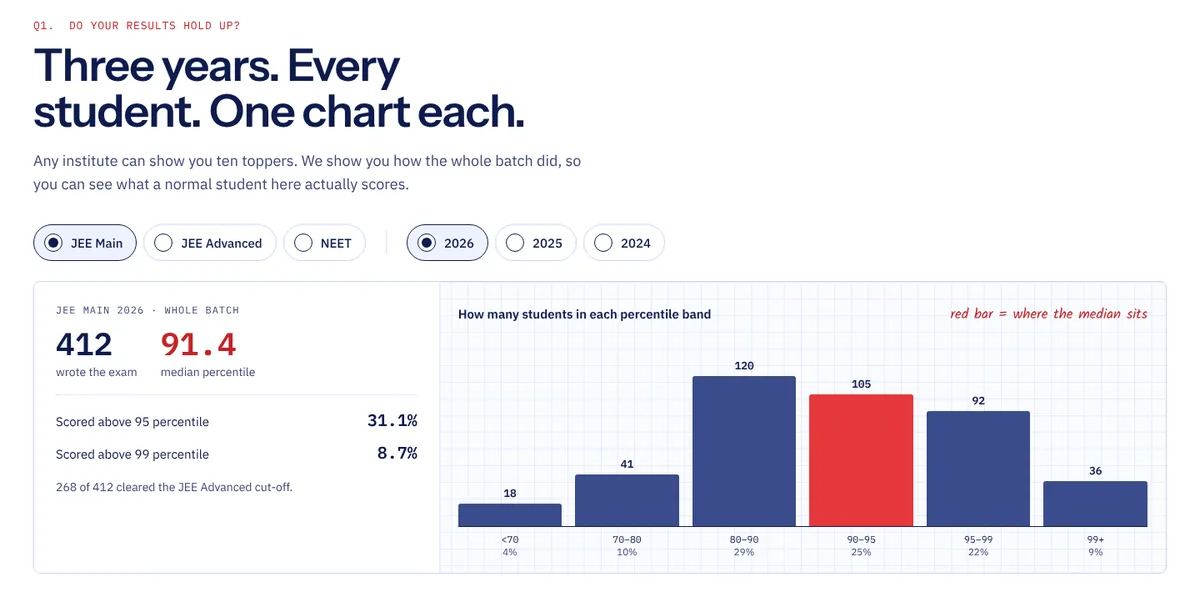
“Three years. Every student. One chart each.” Bubble buttons switch between JEE Main, JEE Advanced and NEET, and between 2024, 2025 and 2026. Each view shows how many wrote the exam, the median, and a bar chart of how many students landed in each percentile band, with the median’s band in red. Under NEET, a line says the results include every student who enrolled for a full year, including those who scored under 450.
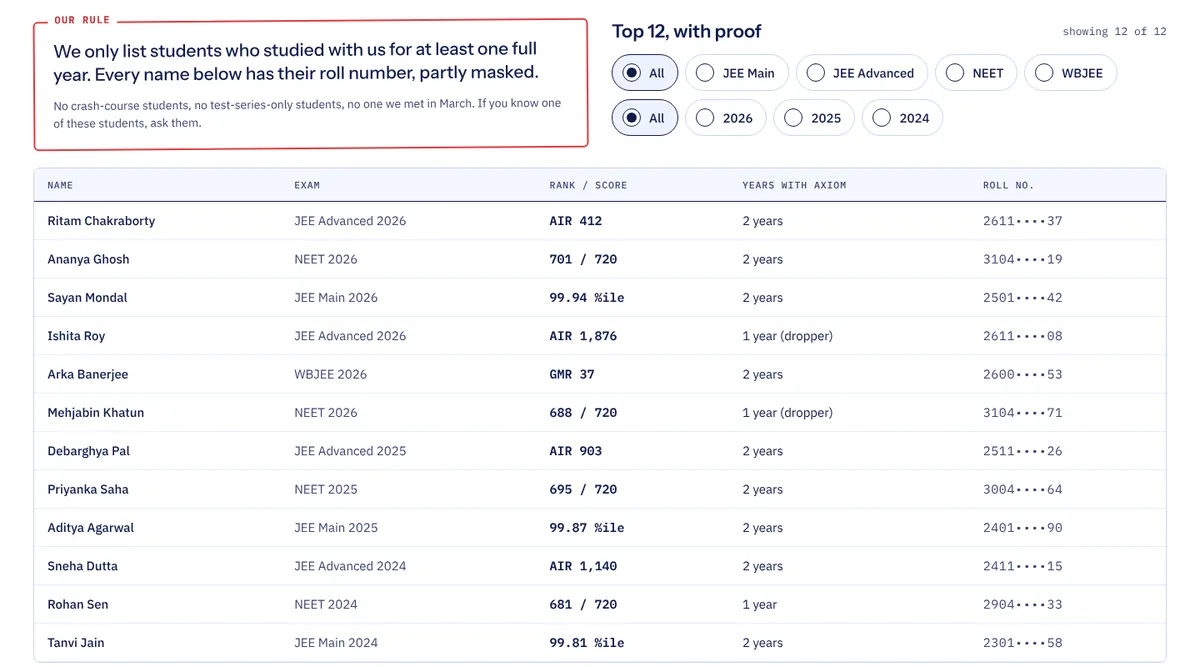
Below the charts is the rule, boxed in red: “We only list students who studied with us for at least one full year. Every name below has their roll number, partly masked. No crash-course students, no test-series-only students, no one we met in March.” The table of 12 toppers shows each one’s exam, rank or score, years with Axiom and a masked roll number like 2611••••37, filterable by exam and year.
Step 04
A free test inside the page
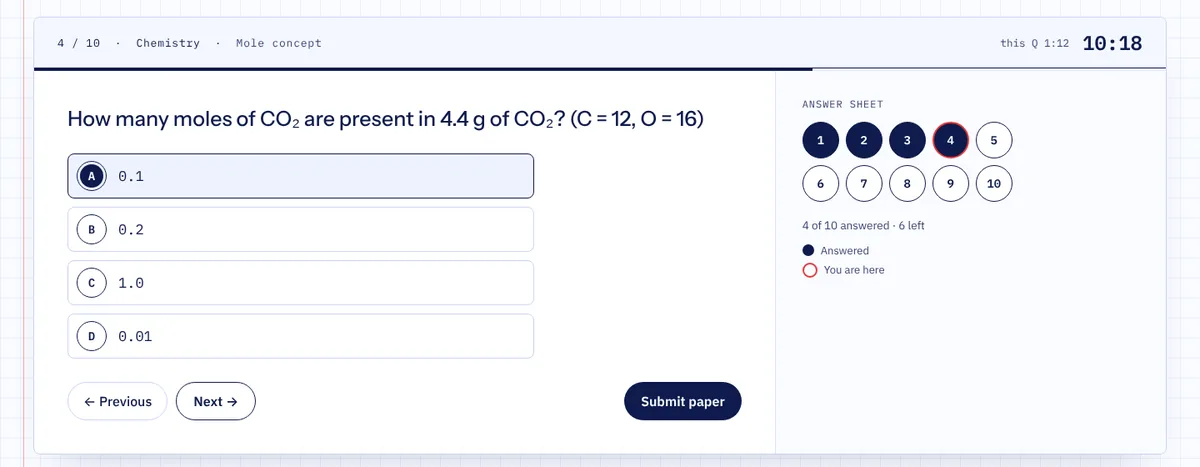
Q2 asks “Is my child ready?”, and the site answers by letting the student find out: “10 questions. 15 minutes. No sign-up.” They pick JEE or NEET and their class, and start a timed paper of real-exam difficulty: for JEE, 3 Physics, 3 Chemistry and 4 Maths questions. Options are OMR-style bubbles, an answer sheet on the side fills in as they go, and there is a timer for the paper and one for the current question.
At the end, the student gets a score circled in red pen, accuracy, average time per question, a chapter-by-chapter tick or cross with the time spent on each, a score by subject, and a suggested batch with the reason: “A solid base with a few gaps, mainly Laws of motion and Chemical bonding. The Foundation batch rebuilds these in the first 8 weeks.” The next step is one button: “Get a free counselling call about this.”
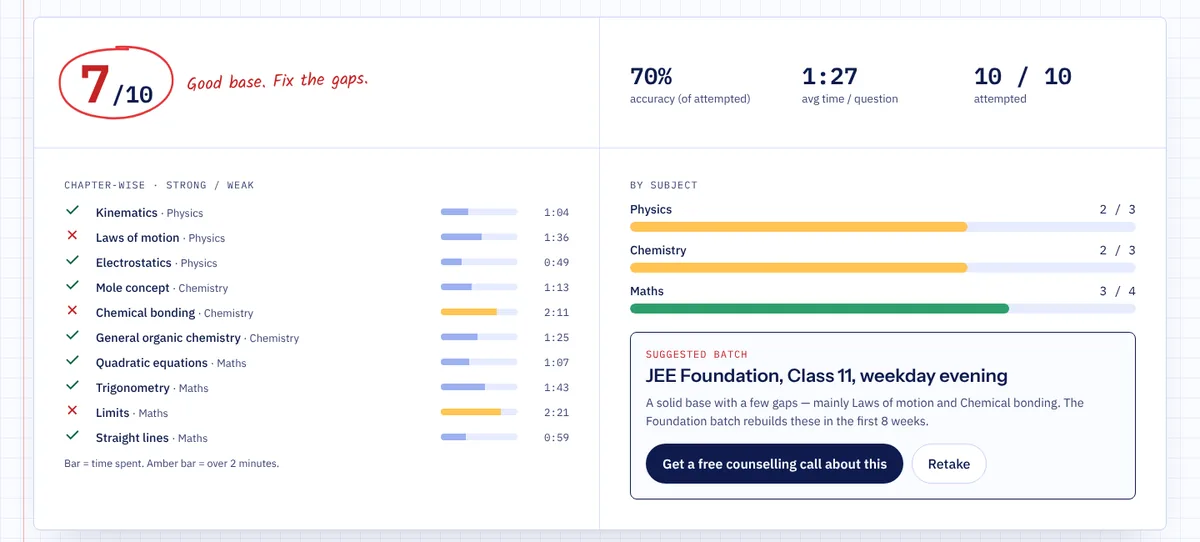
For the institute: every student who finishes the test is a warm lead, and the counsellor already knows their score, weak chapters and the batch to suggest.
Step 05
Fill four bubbles, see real seats
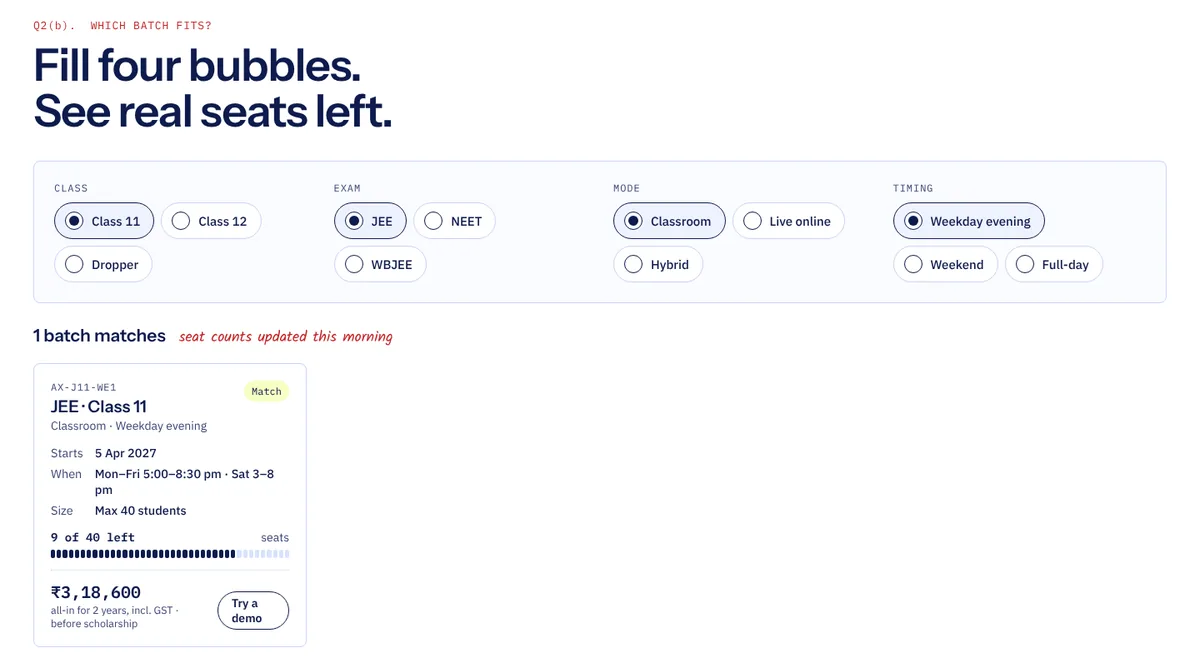
“Fill four bubbles. See real seats left.” The student picks their class, exam, mode (classroom, live online or hybrid) and timing. Matching batches appear as cards with a batch code, start date, days and times, the maximum size of 40, a seat bar like “9 of 40 left”, and the all-in fee for two years including GST, with a note that seat counts were updated this morning.
Step 06
A real week, and doubts in 11 minutes
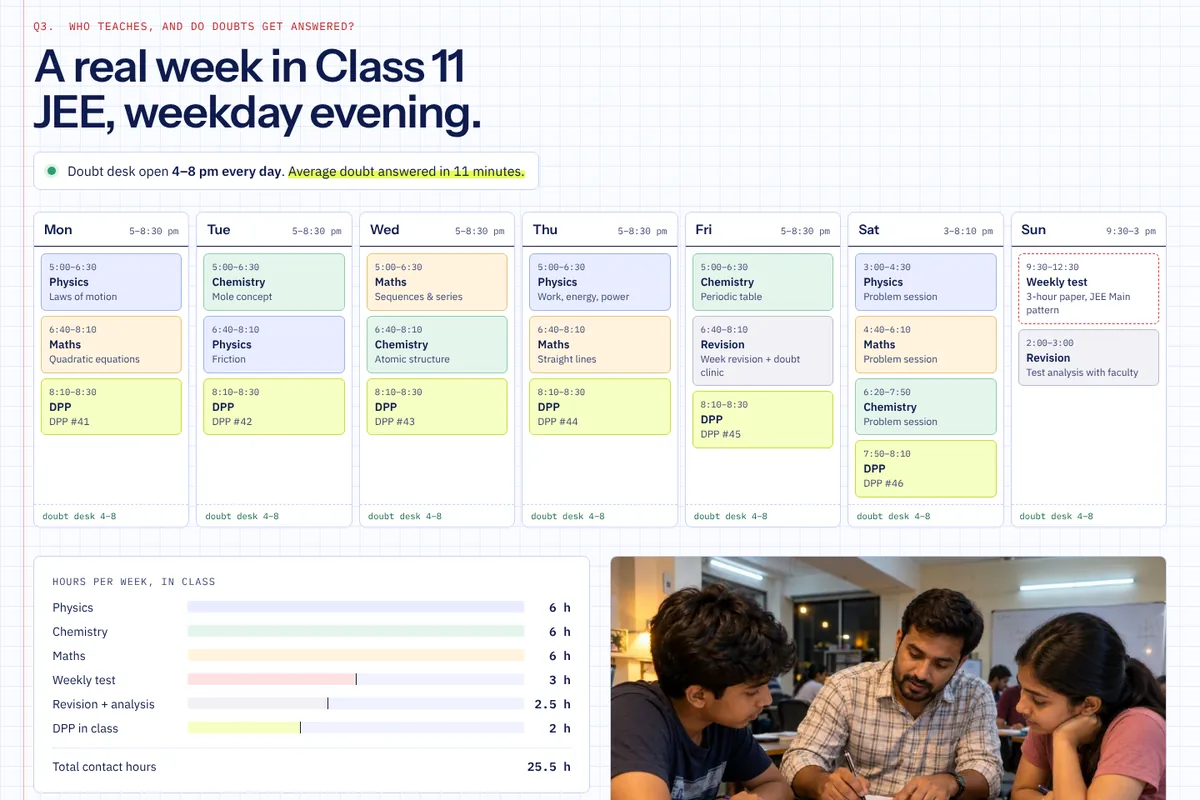
Q3 is answered first with a timetable: “A real week in Class 11 JEE, weekday evening.” Each day shows its lectures with the actual chapter, the daily practice problems (DPP) and the timings, with the Sunday 3-hour test and its analysis. A bar chart adds up the hours per subject to 25.5 contact hours a week. A green line at the top says “Doubt desk open 4–8 pm every day. Average doubt answered in 11 minutes.” A photo of the doubt desk at 6:40 pm sits next to four rules, including “Missed a class? The recording is up by 10 pm the same day.”
Step 07
The teachers you meet are the ones who teach
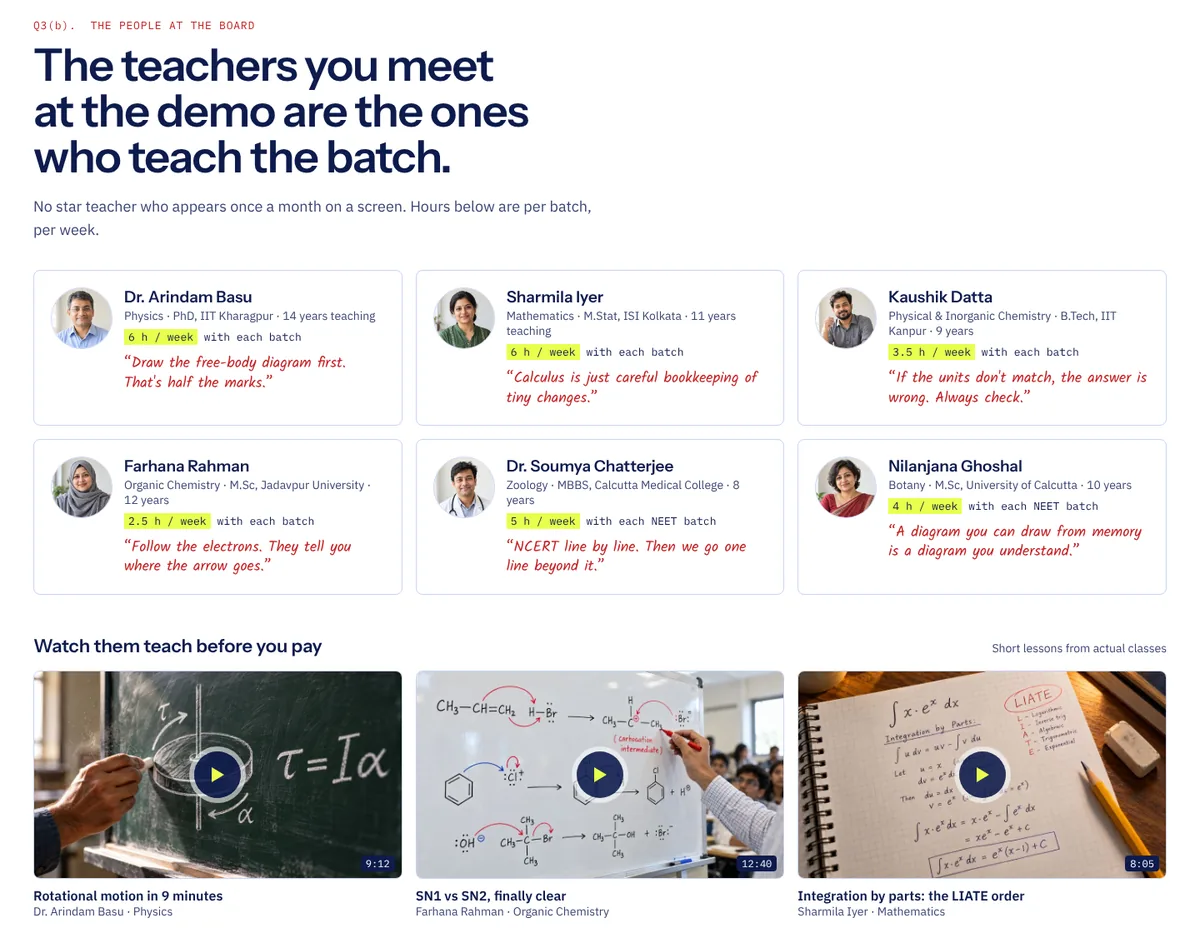
“The teachers you meet at the demo are the ones who teach the batch.” Six faculty cards show the subject, degree and college, years of teaching, and a yellow tag with hours a week with each batch, plus one line in their own words, like “Draw the free-body diagram first. That’s half the marks.” Below them, three short lessons from real classes have play buttons: Rotational motion in 9 minutes, SN1 vs SN2, finally clear, and Integration by parts: the LIATE order.
Step 08
Progress the student and parent can both see
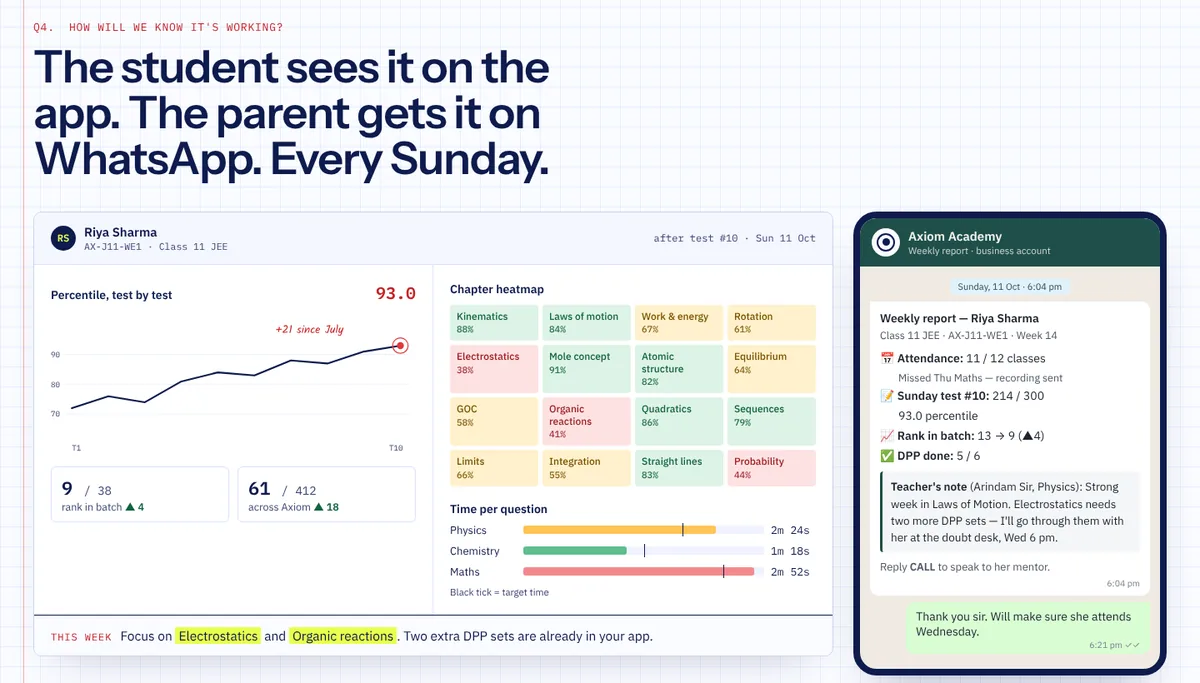
Q4 gets a headline that explains the whole system: “The student sees it on the app. The parent gets it on WhatsApp. Every Sunday.” The student dashboard shows the percentile test by test (up 21 since July), rank in batch and across Axiom, a chapter heatmap in green, amber and red, time per question against a target, and “This week: focus on Electrostatics and Organic reactions.” Next to it, the parent’s WhatsApp report shows attendance, the Sunday test score, the rank change, DPPs done and a note from the physics teacher.
For the institute: fewer students drop out mid-year, and parents renew for year two because they saw every week of year one.
Step 09
The whole fee, and a refund policy in plain words
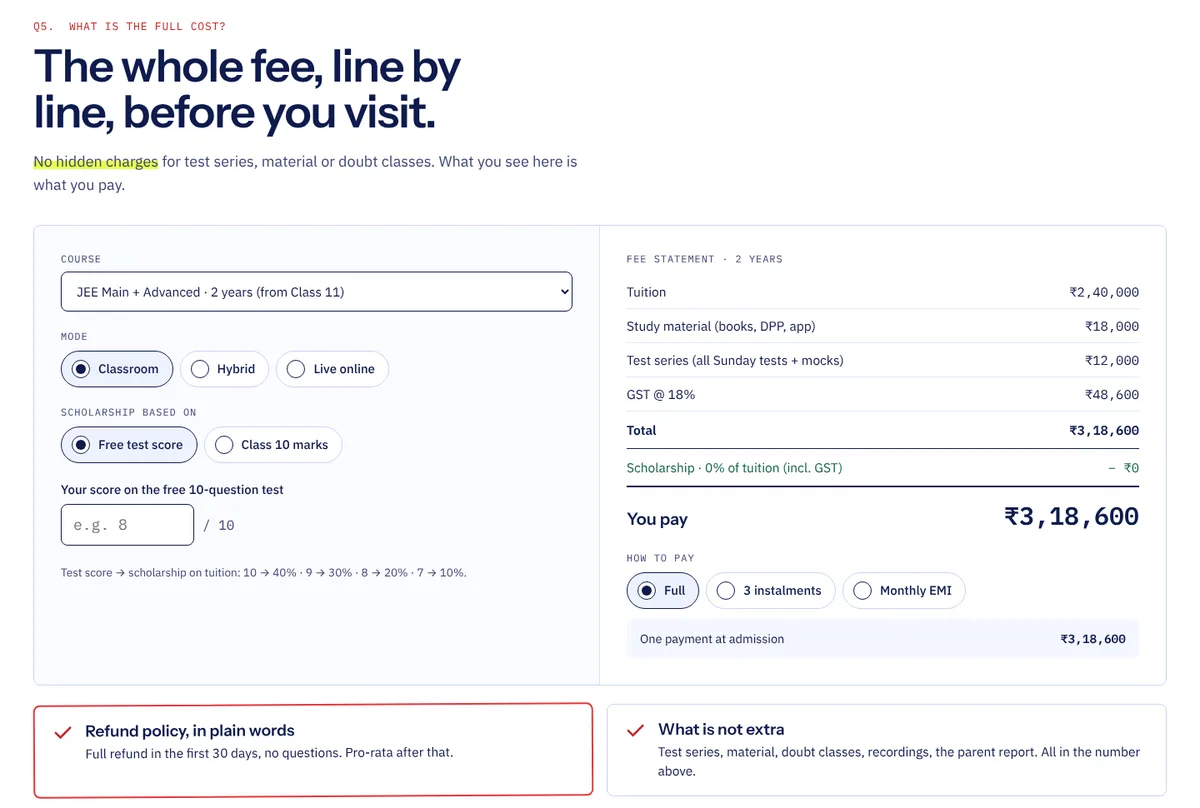
Q5 is answered with “The whole fee, line by line, before you visit.” The student picks the course and mode, and enters their score on the free test (or their Class 10 marks) to see the scholarship: 10/10 gets 40% off tuition, down to 10% for 7/10. The fee statement lists tuition, study material, the test series and GST, the total, the scholarship and what they actually pay, with options for one payment, three instalments or monthly EMI.
Two boxes underneath answer the last worries: a refund policy in plain words, “Full refund in the first 30 days, no questions. Pro-rata after that.”, and “What is not extra”: test series, material, doubt classes, recordings and the parent report.
For the institute: families commit sooner, and the scholarship gives every student who took the test a reason to come back to the page.
Step 10
For students from outside Kolkata
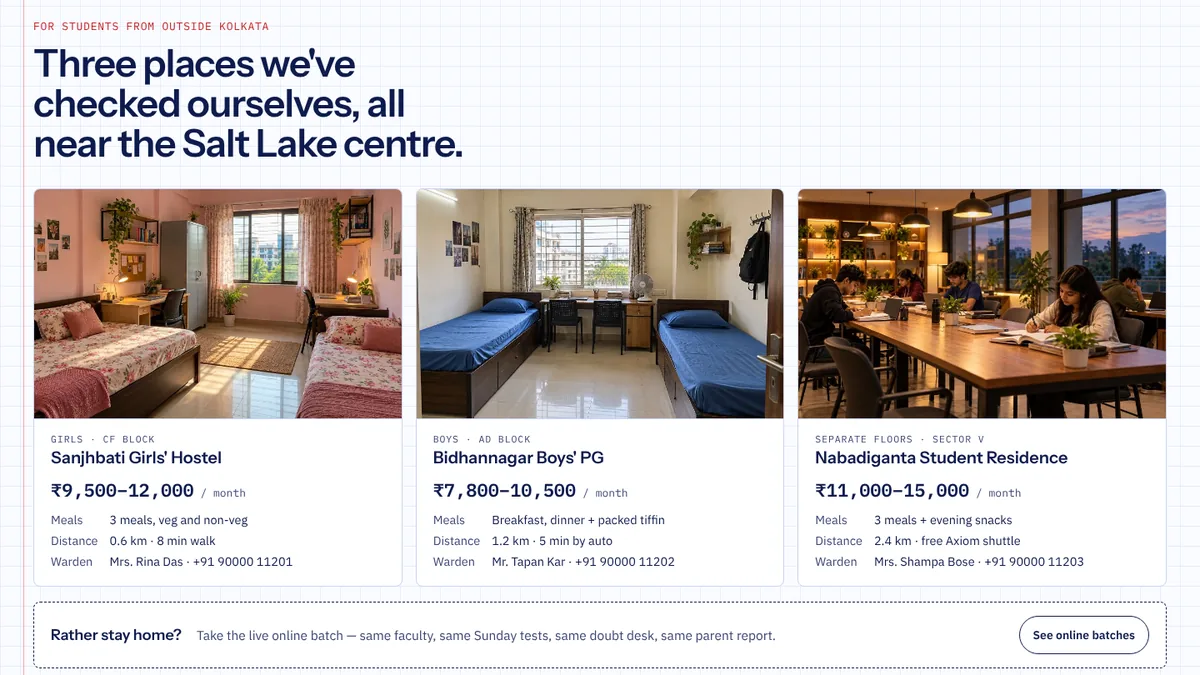
Many coaching students move cities. “Three places we’ve checked ourselves, all near the Salt Lake centre” lists a girls’ hostel, a boys’ PG and a residence with separate floors, each with monthly cost range, meals, distance and the warden’s name and number. A dashed box offers the alternative: “Rather stay home? Take the live online batch: same faculty, same Sunday tests, same doubt desk, same parent report.”
For the institute: families outside Kolkata, often the most motivated ones, can plan the move from the website instead of a separate trip.
Step 11
Sit in a real class, or talk to a teacher
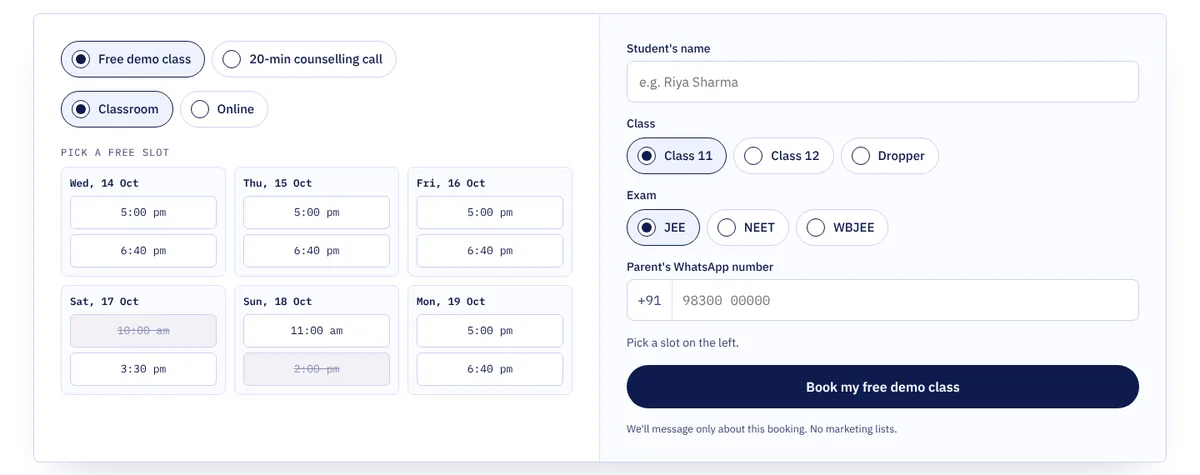
The page ends with “Sit in a real class, or talk to a teacher for 20 minutes.” and the promise “A senior teacher calls you back, not a sales team.” Students choose a free demo class (classroom or online) or a counselling call, pick a free slot from the next six days, and fill in four things: their name, class, exam and a parent’s WhatsApp number. Under the button: “We’ll message only about this booking. No marketing lists.”
Step 12
It works on a phone
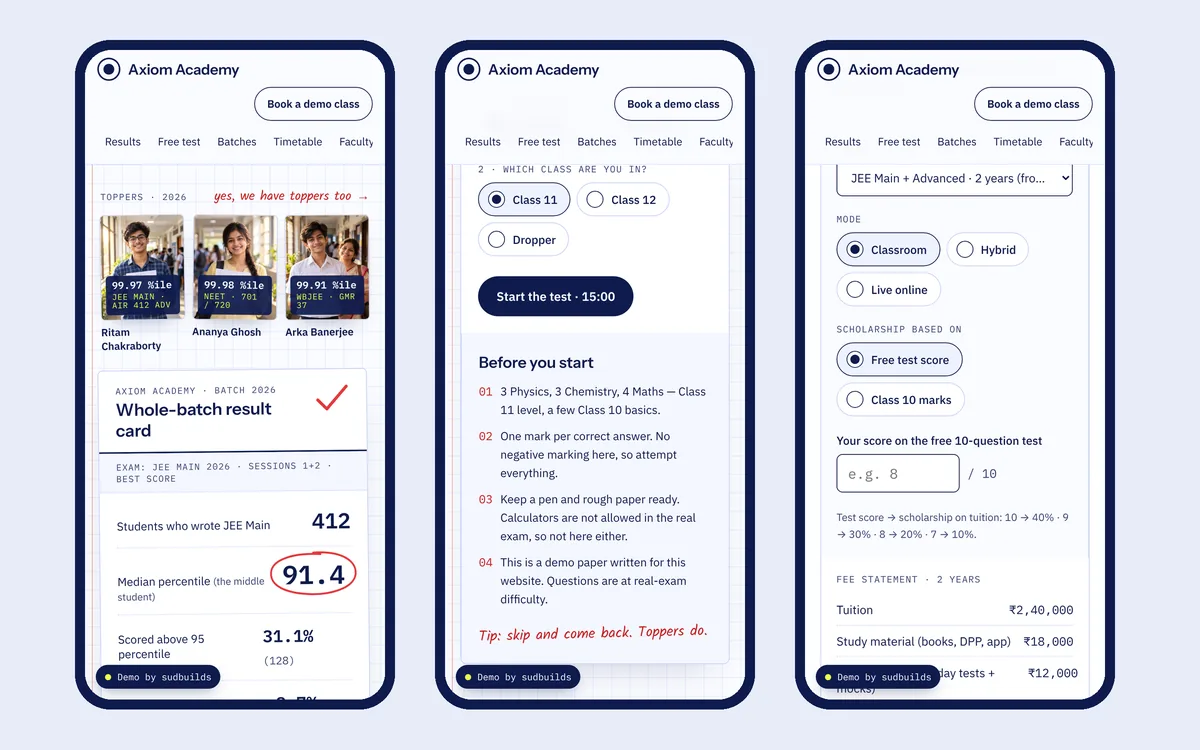
Almost every student first sees a coaching institute’s link on their phone. On a small screen the menu becomes a row that scrolls sideways, the result card and test stack into one column with large bubbles for thumbs, the toppers table and the weekly timetable scroll sideways inside their own boxes, and the fee calculator fits the screen.
At a glance
The psychology at a glance
Every principle used on the site, where it shows up, and what it does for students and parents.
| Principle | Where it’s used | What it does |
|---|---|---|
| Persuasion knowledge | Evidence instead of topper ads | Gets past years of distrust |
| Base rates | The median, circled in the hero | A number about their own child |
| Costly signals | Masked roll numbers, the one-year rule | Toppers are believed |
| Two-sided message | Students under 450 included | The good numbers are believed |
| Reciprocity | Free chapter-wise test | Value before the sale |
| Honest scarcity | Seats left, updated this morning | Earlier decisions |
| Labor illusion | A real week, 25.5 hours | The fee feels earned |
| Authority you can test | Faculty hours, lessons to watch | Trust in the teaching |
| Progress principle | Percentile line, chapter heatmap | Students keep going |
| Operational transparency | Sunday WhatsApp report | Parents renew |
| Status quo bias, eased | 30-day full refund | Easier to say yes |
| Fogg Behavior Model | Four fields, real slots, a teacher calls | More demo classes booked |
Your turn
Steal this for your own institute’s website
You don’t need a full rebuild to use these. Most can be added to the site you have.
- Publish the median result of your whole batch for each exam, next to your toppers.
- Write down your rule for who counts as your student, and add masked roll numbers to the toppers list.
- Put a short free test on the site that gives a chapter-wise result and suggests a batch.
- Show seats left per batch, with the date you updated it.
- Show one real week’s timetable and your average doubt-answer time.
- List each teacher’s hours with each batch, and post two or three short lessons.
- Publish the full fee with GST, the scholarship rules and the refund policy in plain words.
- Send parents a short weekly report on WhatsApp, and show a sample on the site.
Questions
Questions people ask
How much does a coaching institute website like this cost?
It depends on what it connects to. A site with fixed result charts and a booking form is very different from one where the test, seat counts and progress reports come from your own systems. Send me your courses and how admissions work, and I’ll give you a fixed price before any work starts.
Can the free test use our own questions?
Yes. The questions, chapters, scoring and batch suggestions all come from a simple question bank your faculty can edit. Results can also be saved to your CRM so counsellors see them before the call.
Won’t publishing the median make us look worse than competitors?
Only if your median is weak, and then families will find out after joining anyway. For most institutes the median is a strong number that nobody else publishes, so it becomes the thing families remember about you.
Can the weekly parent report really go out on WhatsApp?
Yes, through the WhatsApp Business Platform. Test scores, attendance and a teacher’s note can be sent automatically every Sunday, and parents can reply to reach the mentor.
Will a site like this rank on Google?
The structure helps: pages for each exam, course and centre, real results and fast pages are what students search for. Ranking also depends on your city and competition, so I plan content and links with you.
Are Axiom’s students, results and teachers real?
No. Axiom Academy is fictional, and its students, results, faculty, fees and hostels are placeholders. For a real institute, everything is replaced with your own results, people and numbers before launch.
Further reading
Sources and further reading
The principles above come from published research in psychology and behavioural economics. If you want to read further:
- Friestad, M. & Wright, P. (1994). The persuasion knowledge model: how people cope with persuasion attempts. Journal of Consumer Research.
- Kahneman, D. & Tversky, A. (1973). On the psychology of prediction. Psychological Review.
- Spence, M. (1973). Job market signaling. Quarterly Journal of Economics.
- Eisend, M. (2006). Two-sided advertising: a meta-analysis. International Journal of Research in Marketing.
- Cialdini, R. B. (1984). Influence: The Psychology of Persuasion.
- Worchel, S., Lee, J. & Adewole, A. (1975). Effects of supply and demand on ratings of object value. Journal of Personality and Social Psychology.
- Buell, R. W. & Norton, M. I. (2011). The labor illusion: how operational transparency increases perceived value. Management Science.
- Amabile, T. M. & Kramer, S. J. (2011). The Progress Principle. Harvard Business Review Press.
- Samuelson, W. & Zeckhauser, R. (1988). Status quo bias in decision making. Journal of Risk and Uncertainty.
- Fogg, B. J. (2009). A behavior model for persuasive design. Proceedings of Persuasive 2009.