Case study · School website
A school websitethat answers the tourbefore the visit
Aranya School is a website I designed and built as a demo for a CBSE school in Bengaluru. This is the full walkthrough: what each section does, how parents use it, and the psychology that turns a family comparing five schools into a booked campus visit.

In one minute
- The site is built around the five questions parents ask on every campus tour, answered in that order, with a contents list on the first screen.
- Parents see a day in their child’s class, safety rules with exactly how each one works, and board results for the whole class, not just toppers.
- A fee calculator shows the full year, line by line, and a bus finder shows their stop, pickup time and ride length.
- Admission shows the right class from a date of birth and the real seat count.
- There are no photos of children: the campus is illustrated, and the site says why.
Who this is for
Schools of every board, preschools and colleges, and anyone who sells to parents making a long, careful decision.
Every idea here works on an existing site too. There’s a checklist at the end.
Jump to the checklistOn this page
- Start with the questions parents ask on the tour
- A first screen that says “check everything”
- No photos of children, on purpose
- Six safety promises, and exactly how each one works
- Results for the whole class, not just the toppers
- Teachers who stay
- The whole fee, line by line
- Find your stop
- The right class and the real seat count
- The parent app, with boundaries
- A campus map you can tap
- The mandatory disclosure, readable
- Book a visit with a teacher
- It works on a phone
- The psychology at a glance
- Steal this for your own school website
- Questions people ask
Parents choosing a school compare three to five of them, visit each one, and ask the same questions every time: is it safe, will my child learn, what does it really cost, how do they get there, and is there a seat. Most school websites answer none of them. They show a photo slider, a principal’s message, a gallery from Annual Day, and a PDF somewhere with the fee.
With Aranya I set one rule: every question a parent asks on the tour should be answered on the page, with a number, a name or a document they can check. Below is each section in the order you meet it, with the screenshot, what it does and the psychology behind it.
Aranya School is a design demo. The school, results, fees, staff, bus routes and seat counts are fictional placeholders, and for a real school they are replaced with the real ones before launch. The design decisions and the psychology are what this post is about.
Step 01
Start with the questions parents ask on the tour
Choosing a school is one of the biggest decisions a family makes, and one of the hardest to judge. Parents can’t try a school for a year and switch. They compare three to five schools, visit each one, and ask the same questions on every tour. So I wrote those questions down, in the order parents ask them:
- Is my child safe here?
- Will they learn well, and be happy?
- What will it really cost, every year?
- How do they get there and back?
- How do we get admission, and is there a seat?
Most school websites open with a photo slider, a principal’s message about “holistic development” and an “Admissions open” banner. The answers parents need are in a PDF, on a different page, or only on the tour. Aranya’s site answers each question in a section of its own, labelled with the question itself.
For the school: parents arrive on the tour with their basic questions already answered, so the visit is about the feel of the place, which is when families decide.
Step 02
A first screen that says “check everything”
A thin blue bar at the very top is for parents whose children already study here: Pay fees · Circulars · Bus live · Calendar · Parent app. Below the menu is a hand-painted illustration of the school gate at 8:20 am, with yellow buses, a guard and a big tree. A yellow note on it says “drawn for us, because we don’t put children’s photos online.”
Under the illustration, on ruled notebook paper, the headline reads “Check everything. Then come and see us.”, with the word Check circled in red pen. Below it is a contents list of the five questions with section numbers, like the first page of an exercise book.
On the right is “A day at Aranya”. Pick Nursery, Class 3, Class 8 or Class 11 and a timetable fills in: 7:40 bus pickup, 9:10 maths in pairs, fractions with paper strips, 12:20 lunch, cooked here, eaten with their class teacher, 2:00 football or music, their choice. A strip of facts finishes the hero: a 1:14 teacher ratio, at most 28 children in a class, 94% of teachers staying 3+ years, and the CBSE affiliation number with a link to check it.

For the school: parents see the school as a place where their child would spend real days, not a brochure, in the first few seconds.
Step 03
No photos of children, on purpose
Every image on the site is an illustration: the gate, the bus, the library, the pool, the kitchen and the lesson photos are all painted, with no recognisable children. The site says so twice, once on the hero and once on the campus map.
This started as a practical choice and became a selling point. India’s Digital Personal Data Protection Act, 2023 requires verifiable consent from a parent before a child’s personal data is processed, and many parents don’t want their child’s face on a school’s website or ads. A school that shows it has thought about this tells parents something important before they read a single policy.
For the school: the school looks careful with children’s privacy from the first screen, and never has to chase consent forms for website photos.
Step 04
Six safety promises, and exactly how each one works
The first question gets the most space. The heading is “Six promises, and exactly how we keep each one.” Each promise has a How it works line with real numbers and names: all 286 staff police-verified, including 31 drivers and 31 bus attendants; 164 cameras on gates, stairs, corridors and buses, none in classrooms or toilets, footage kept 30 days; a nurse from 7:30 am to 4 pm and a paediatrician on call; a QR gate pass for up to 4 named adults per child; a female attendant on every bus; and a named counsellor who replies to every report within 48 hours.
Below it, “What happens if…” answers the four things parents worry about most, step by step with the time each step takes: my child is unwell, the bus is late, my child is being bullied, there is an emergency. The safety officer is named, with his email.
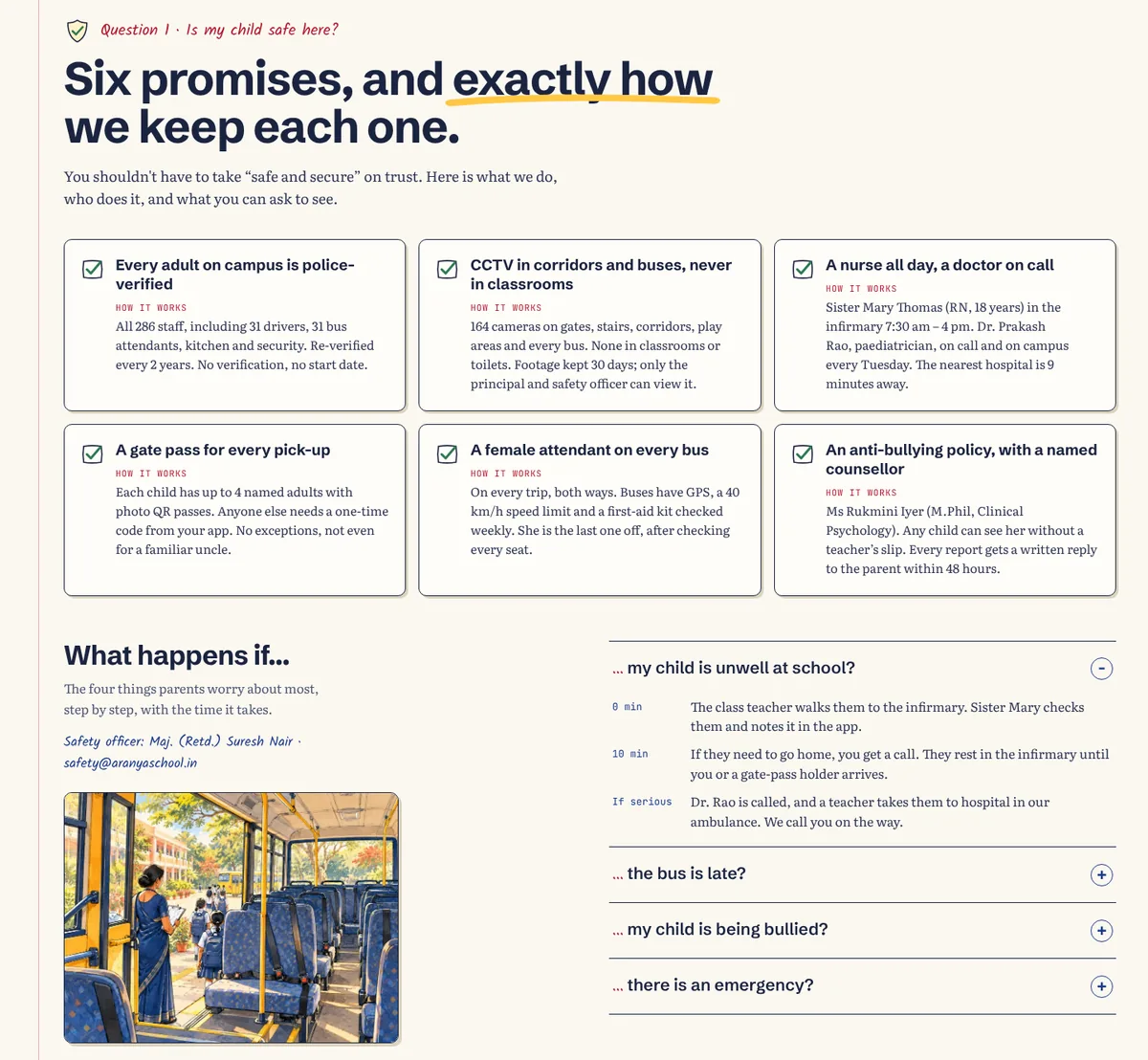
For the school: safety, the question that decides most admissions, is answered with details a parent can quote to their family that evening.
Step 05
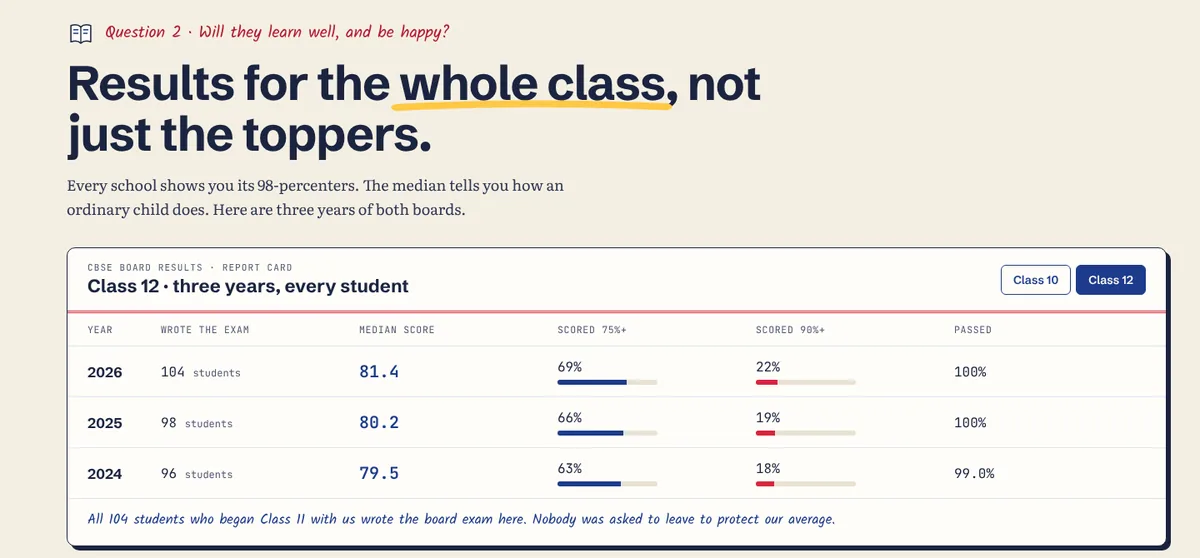
Results for the whole class, not just the toppers
The second question, “Will they learn well, and be happy?”, starts with board results shown like a report card. For three years of Class 10 and Class 12 results, the table shows how many students wrote the exam, the median score, the share who scored 75% and 90%, and the pass rate. A handwritten line underneath says “All 104 students who began Class 11 with us wrote the board exam here. Nobody was asked to leave to protect our average.”
Next to the results is “Where the Class of 2026 went next”: all 104 students, by field, with the colleges named, including the 9 taking a gap year, working or reappearing. Below it are three real-looking lessons, “Why does ice melt faster in some cups?”, “Is the canteen queue fair?” and “Why did tomatoes cost ₹80 in July?”, and a table of clubs and sports with the number of students in each.
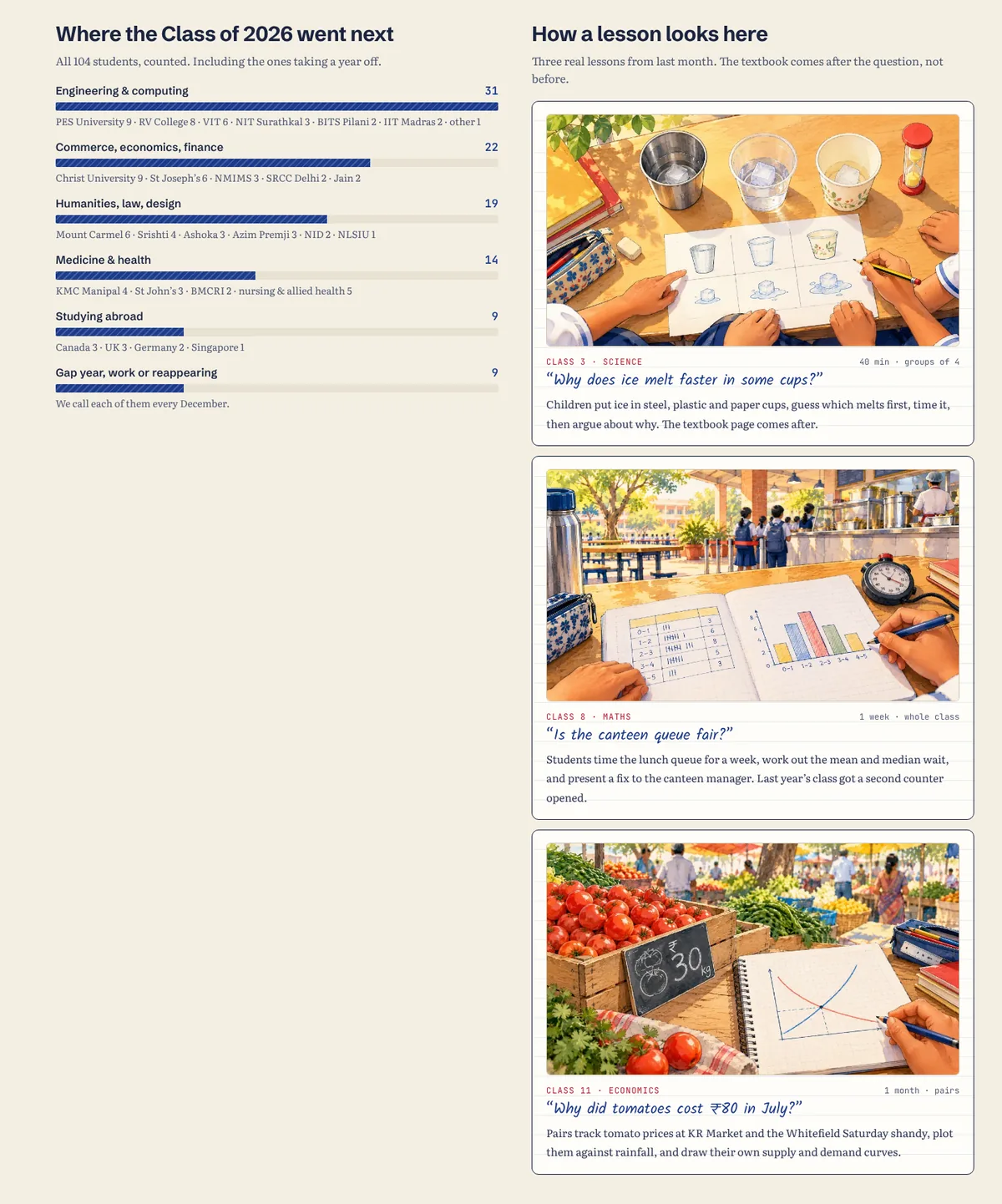
For the school: parents who have seen five schools’ topper banners finally get a number they can compare, and remember the school that gave it to them.
Step 06
Teachers who stay
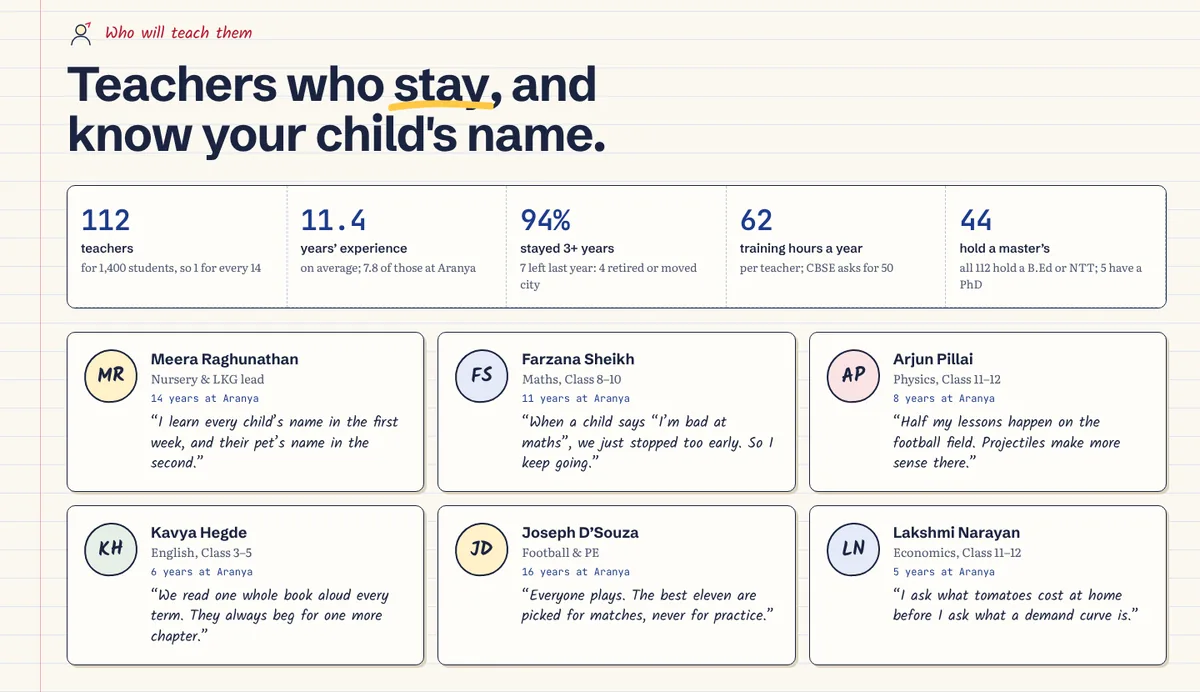
“Teachers who stay, and know your child’s name.” A strip of numbers: 112 teachers, 11.4 years of experience on average, 94% stayed 3+ years (7 left last year, 4 of them retired or moved city), 62 training hours a year each, and 44 with a master’s degree. Below are six teacher cards with initials, subject, years at Aranya and one line in their own words, like the maths teacher’s “When a child says ‘I’m bad at maths’, we just stopped too early.”
Step 07
The whole fee, line by line
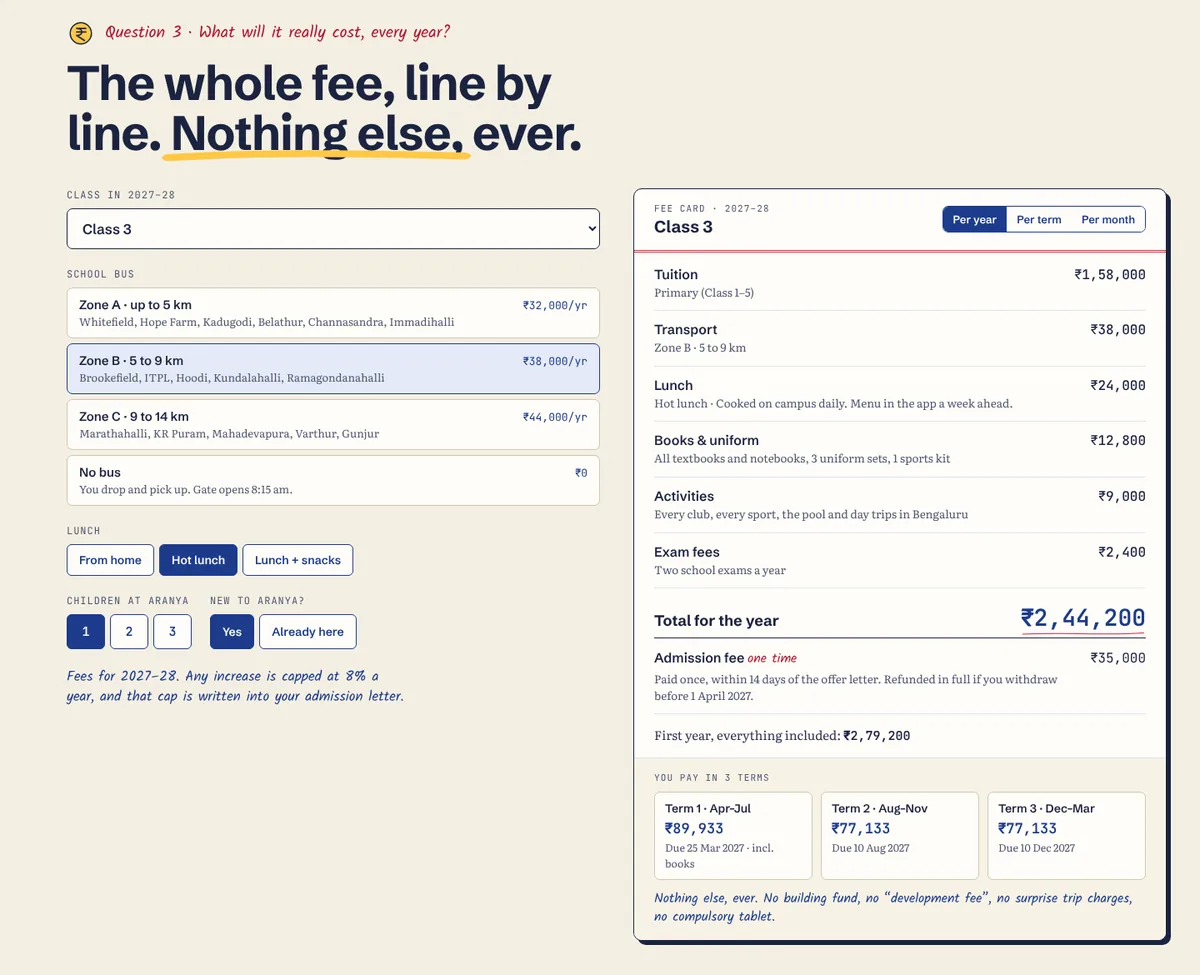
The third question gets a calculator titled “The whole fee, line by line. Nothing else, ever.” Parents pick the class, the bus zone (with the areas in each), the lunch plan, how many children they have at Aranya and whether they are new. The fee card shows tuition, transport, lunch, books and uniform, activities and exam fees, the total for the year, the one-time admission fee and the first-year total, with a switch for per year, per term or per month, and the three term payments with due dates.
Two handwritten notes finish it: any increase is capped at 8% a year, written into the admission letter, and “No building fund, no ‘development fee’, no surprise trip charges, no compulsory tablet.” The admission section adds that there is no capitation fee and no donation, ever.
For the school: parents compare schools on the real number, and the admission office stops spending half of every call explaining the fee sheet.
Step 08
Find your stop
The fourth question, “How do they get there and back?”, is answered with “Find your stop. No ride is longer than 50 minutes.” Parents type their area or tap one (Whitefield, Marathahalli, KR Puram, Brookefield and others). The card shows the nearest stop, the morning pickup and afternoon drop times, the ride length, the bus fee and zone, and the driver’s and attendant’s names. Next to it, the route is drawn like a metro line, with every stop and its time and your stop circled.

Step 09
The right class and the real seat count
The fifth question has two parts, and the section answers both. Parents enter their child’s date of birth and see the age on 31 March and which class they can join, using the CBSE age rule, with the real seat count: Class 1 · 8 of 112 seats left, shown as a grid of dots, taken and open, with the date it was updated. Next to it is a five-step timeline with dates for this cycle, saying that the Nursery to Class 2 interaction is not a test. Below it is a document checklist parents can tick, with a counter: 0 of 6 ready.

For the school: applications come in earlier, and complete, and parents don’t call to ask which class their child should join.
Step 10
The parent app, with boundaries
“One app. Six things you’ll actually open.” A phone mockup shows a Class 3 child’s day: present at 8:41, the bus two stops away, homework due Wednesday, a fee receipt, two new circulars, and a note from the class teacher. The text lists the six features and adds two promises: no ads and no data sold, and teachers reply between 4 and 6 pm on school days, so they can teach the rest of the time.

Step 11
A campus map you can tap
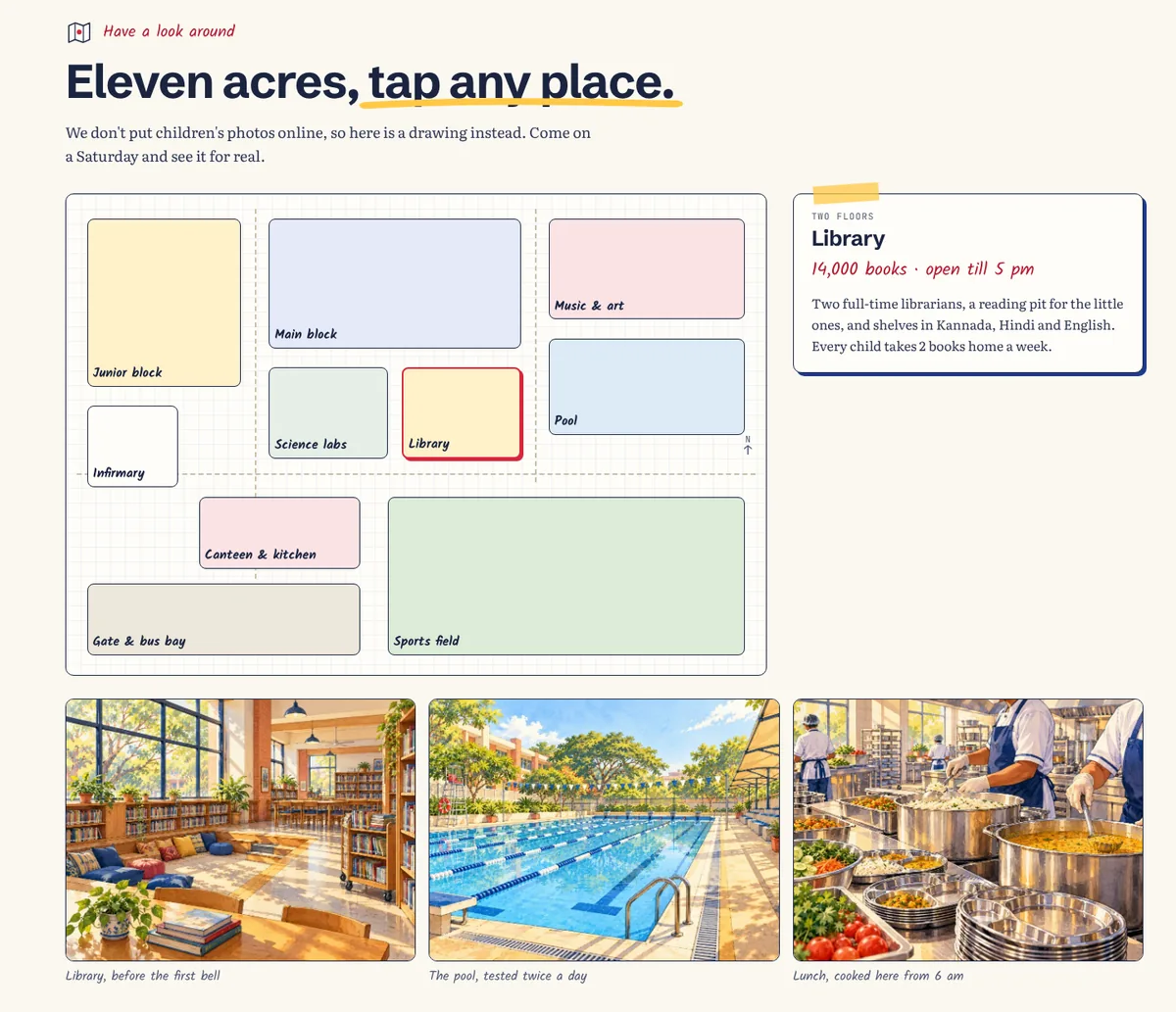
“Eleven acres, tap any place.” The campus is drawn as a simple map on graph paper: the junior block, main block, science labs, library, music and art, pool, infirmary, canteen, gate and sports field. Tapping a place shows a card like Library · 14,000 books · open till 5 pm, with a short description. Three illustrations below show the library, the pool and the kitchen.
For the school: parents know the campus before they visit, and the tour becomes a walk through places they already want to see.
Step 12
The mandatory disclosure, readable
CBSE requires every affiliated school to publish a mandatory public disclosure on its website: general information, documents, results, staff and infrastructure. Most schools upload a scanned PDF three menus deep. Aranya’s site shows it as a clean, tabbed table on the page, “readable, with every original document one tap away”, with the date it was last updated.

For the school: the school meets a CBSE requirement and turns it into proof of openness, instead of hiding it.
Step 13
Book a visit with a teacher
The page ends with “Book a campus visit.” Parents choose a Saturday tour (75 minutes, up to six families) or a weekday visit (45 minutes, just them, with 20 minutes sitting in on a class), pick a date and a free time slot, and leave three details: name, child’s class and WhatsApp number. A yellow sticky note says “A teacher, not a sales counsellor, shows you around.”, and under the button: “We’ll only use your number to confirm this visit. No marketing messages.”

For the school: more families book a visit, and the ones who come have read the whole page.
Step 14
It works on a phone
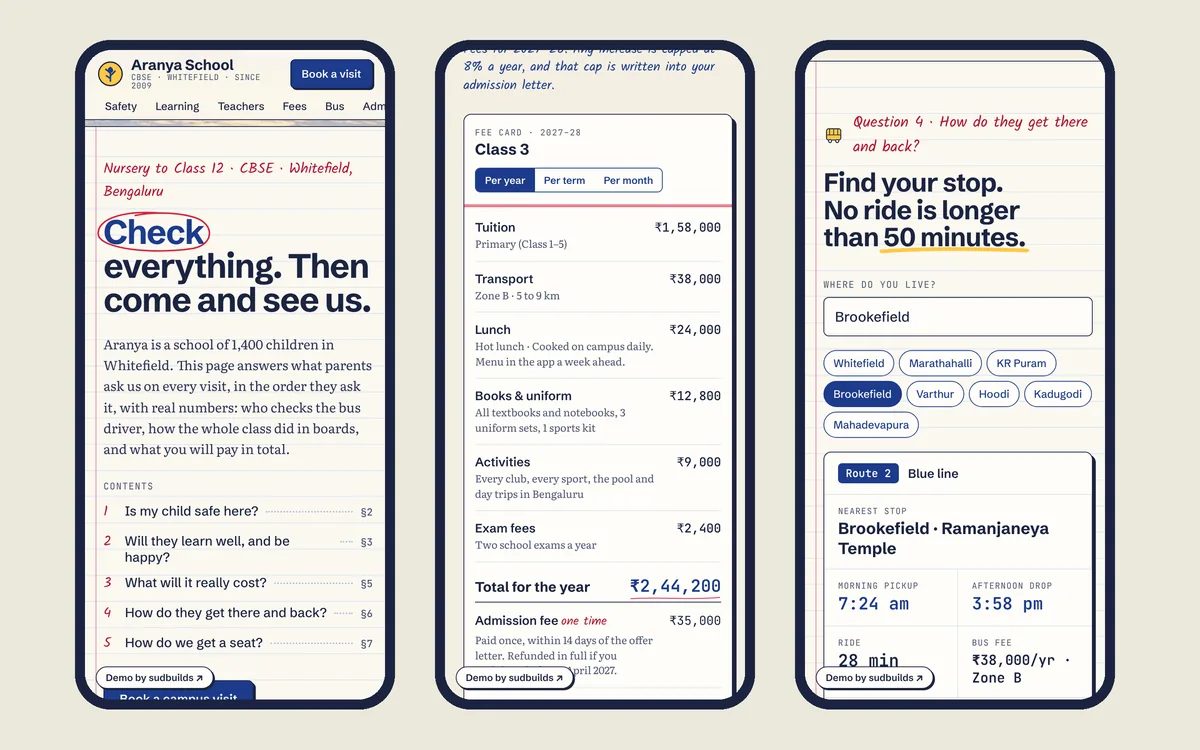
Most parents open a school’s link from a WhatsApp group, on a phone. On a small screen the menu scrolls sideways under the logo, the headline and contents list fill the first screen, the fee card stacks into one column with the total underlined in red, and the bus finder’s area buttons wrap so they are easy to tap.
For the school: the link forwarded in a parents’ WhatsApp group answers the group’s questions on its own.
At a glance
The psychology at a glance
Every principle used on the site, where it shows up, and what it does for parents.
| Principle | Where it’s used | What it does |
|---|---|---|
| Credence goods | Five questions, answered with proof | Gives parents something to check |
| Mental simulation | A day at Aranya | They picture their child there |
| Processing fluency | Contents list on the first screen | The page feels manageable |
| Concreteness | Safety, with how each promise works | Claims are believed |
| Base rates | Median results for the whole class | A number about their child |
| Two-sided message | Gap years counted, why teachers left | The good numbers are believed |
| Liking | Named teachers in their own words | Trust in people, not a brand |
| Drip pricing, avoided | Full fee card, 8% cap | Trust in the price |
| Tailoring | Bus stop and times for their area | The commute feels real |
| Honest scarcity | Seat dots with an update date | Earlier applications |
| Goal gradient | Document checklist with a counter | Complete applications |
| Operational transparency | Parent app, reply hours | Trust in the daily routine |
| Fogg Behavior Model | Three fields, real slots, a teacher guide | More visits booked |
Your turn
Steal this for your own school website
You don’t need a full rebuild to use these. Most can be added to the site you have.
- List the questions parents ask on every tour, and answer each one on your homepage, in that order.
- Show a real day’s timetable for two or three classes.
- For every safety promise, add one line on how it works and who is responsible.
- Publish the median board score and how many students wrote the exam, not only toppers.
- Put the full yearly fee for one class on the site, every line, and say how much it can rise.
- Show the bus stop and times for each area you cover.
- Show seats left per class, with the date you updated it.
- Make your CBSE mandatory disclosure a readable page, and link it from the menu.
Questions
Questions people ask
How much does a school website like this cost?
It depends on what it connects to. A site with fixed fee tables and a visit form is very different from one where seats, bus routes and fees come from your school management software. Send me your school and how admissions work, and I’ll give you a fixed price before any work starts.
Can it connect to our school ERP or app?
Usually, yes. Seat counts, bus routes, fees and circulars can be read from most school ERPs through an export or an API. If that isn’t possible, the admissions team can update them from a simple admin page.
Should a school really publish its fees and median results?
Parents get both on the tour anyway, and they compare schools on them. Publishing them builds trust before the visit and saves the admissions team hours of calls. If your fees vary by class, the calculator handles that.
We have photos of our students. Should we stop using them?
Only use them with clear written consent from each parent for that use. Illustrations of your real campus, like the ones in this demo, avoid the issue entirely and make the site look distinctive.
Will a site like this rank on Google?
The structure helps: pages for admissions, fees, transport and each stage of the school, real numbers and fast pages are what parents search for. Ranking also depends on your area and competition, so I plan content and links with you.
Is Aranya a real school?
No. Aranya School is fictional, and the results, fees, staff, routes and seat counts are placeholders. For a real school, everything is replaced with your own numbers, documents and people before launch.
Further reading
Sources and further reading
The principles above come from published research in psychology and behavioural economics. If you want to read further:
- Darby, M. R. & Karni, E. (1973). Free competition and the optimal amount of fraud. Journal of Law and Economics.
- Elder, R. S. & Krishna, A. (2012). The “visual depiction effect” in advertising: facilitating embodied mental simulation through product orientation. Journal of Consumer Research.
- Reber, R., Schwarz, N. & Winkielman, P. (2004). Processing fluency and aesthetic pleasure. Personality and Social Psychology Review.
- Hansen, J. & Wänke, M. (2010). Truth from language and truth from fit: the impact of linguistic concreteness and level of construal on subjective truth. Personality and Social Psychology Bulletin.
- Kahneman, D. & Tversky, A. (1973). On the psychology of prediction. Psychological Review.
- Eisend, M. (2006). Two-sided advertising: a meta-analysis. International Journal of Research in Marketing.
- Cialdini, R. B. (1984). Influence: The Psychology of Persuasion.
- Central Consumer Protection Authority, India (2023). Guidelines for Prevention and Regulation of Dark Patterns, 2023.
- Gourville, J. T. (1998). Pennies-a-day: the effect of temporal reframing on transaction evaluation. Journal of Consumer Research.
- Noar, S. M., Benac, C. N. & Harris, M. S. (2007). Does tailoring matter? Meta-analytic review of tailored print health behavior change interventions. Psychological Bulletin.
- Worchel, S., Lee, J. & Adewole, A. (1975). Effects of supply and demand on ratings of object value. Journal of Personality and Social Psychology.
- Kivetz, R., Urminsky, O. & Zheng, Y. (2006). The goal-gradient hypothesis resurrected. Journal of Marketing Research.
- Buell, R. W. & Norton, M. I. (2011). The labor illusion: how operational transparency increases perceived value. Management Science.
- Fogg, B. J. (2009). A behavior model for persuasive design. Proceedings of Persuasive 2009.
- Government of India (2023). The Digital Personal Data Protection Act, 2023.